
CUETMOCK
  • Pricing
  • Mentors
Log inStart freeStart free mocks→

First test, then trust

Try a free CUET mock test.

Join 5,00,000+ students who rehearsed exam day on the exact NTA screen before sitting CUET. On the web and on Android.

Start free mocks →Get the Android app
CUETMOCK

India's #1 CUET Mock Test Platform. Original NCERT-based questions on the exact NTA exam screen — trusted by 5,00,000+ students since CUET 2022.

Get it onGoogle PlayScan to download the CUETMOCK app

Mock tests

  • CUET mock test series
  • Commerce mocks
  • Humanities (Arts) mocks
  • Science mocks
  • Languages & GAT mocks
  • Free practice questions
  • Pricing

Resources

  • CUET exam guide
  • CUET syllabus
  • Universities accepting CUET
  • Expert blogs
  • News & notifications
  • Webinars & counselling
  • CUET score calculator
  • How we estimate your rank
  • FAQs

Company

  • About us
  • Our leadership & team
  • Our toppers
  • Mentors
  • For schools
  • Contact us
  • Terms
  • Privacy
  • Refund policy

Talk to us

+91 7696 6630 56info@cuetmock.comWhatsApp us

Our other platforms

  • JEE Mock — For IIT-JEE aspirants
  • NEET Mock — For NEET aspirants

Newsletter

Exam updates, study material and offers — no spam.

© 2026 NYC Ventures Pvt. Ltd.

701-702, Royal Business Park, Zirakpur, Punjab - 140603

  • Terms of use
  • Privacy policy
  • Refund policy
  • Contact us

iCUETMOCK is an independent preparation platform, not affiliated with the National Testing Agency (NTA). Always check exam details on the official NTA website.

  • Home
  • Mock tests
  • CUET guide
  • Pricing
  • Log in
Home/Practice questions/Chemistry
ChemistryPhysical: Chemical Kinetics

Which of the following can be the rate constant of a first order reac…

Which of the following can be the rate constant of a first order reaction?

Answer & explanation+

Correct answer: option 3

The correct answer is Option (3) → 2 x 10⁻² s-1

The unit of rate is always mol L−1 s−1, and since Rate = k[A]n, the unit of k is (mol L−1)1−n s−1. For a first order reaction (n = 1) the concentration part cancels:

    \( \displaystyle \text{Unit of }k=\frac{\mathrm{mol\,L^{-1}\,s^{-1}}}{\mathrm{mol\,L^{-1}}}=\mathrm{s^{-1}} \)

So only 2 × 10⁻² s−1 can be a first order rate constant.

NCERT (2026-27 edition):
Order of a Reaction – …
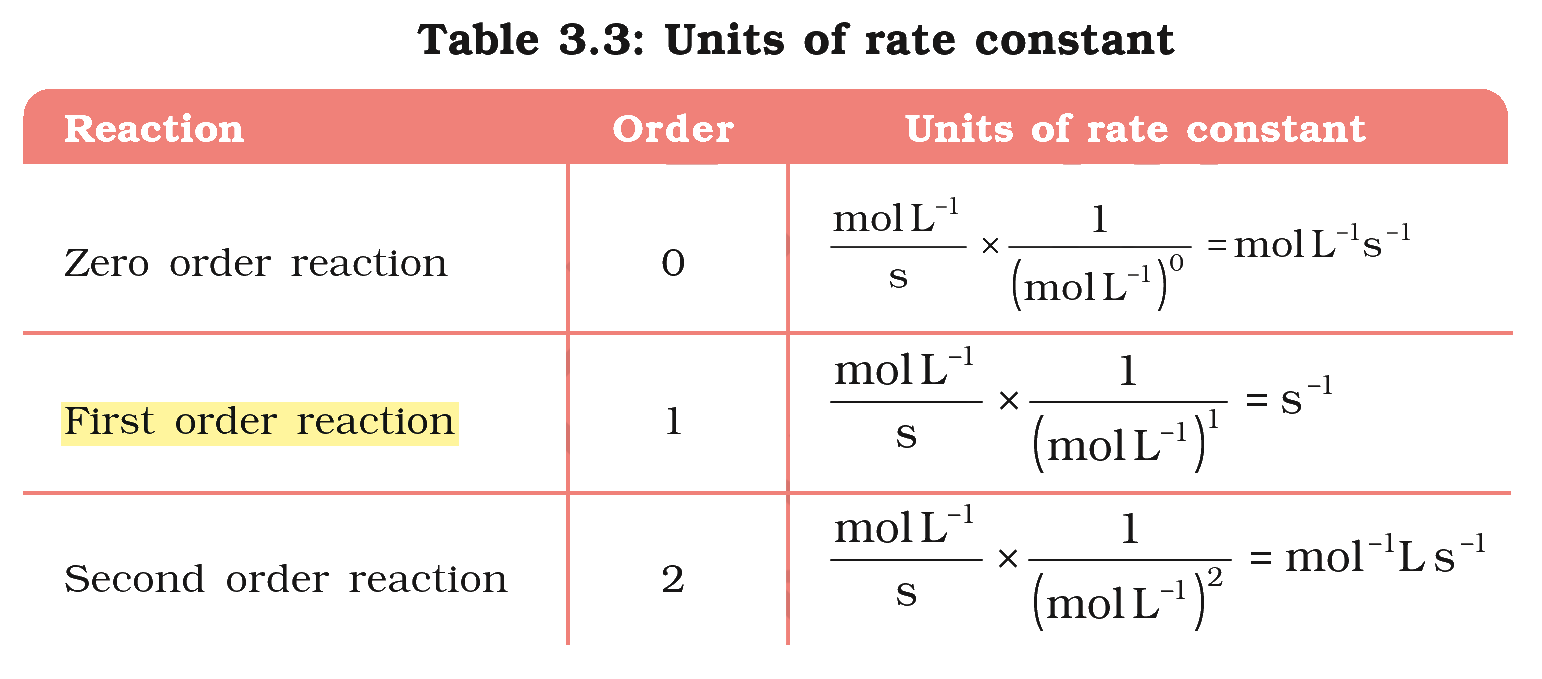
Textbook extract

Advertisement

Practise more on Physical: Chemical Kinetics

Chapter-wise mocks on the real NTA exam screen, with solutions and your rank. Your first mocks are free.

Start free mocks →

Advertisement

Next questions

  1. The average age of Ram and Rahim is 10 years. The average age of Rahim and Ramesh is 15 years. The average age of Ram and Ramesh is 20 year…General Aptitude Test · Numerical Ability
  2. If the student's field site were in Gujarat, which caste would best fit her description?Sociology · Indian Society: Continuity and Change
  3. Choose the correct statement about GlobalizationPolitical Science · Contemporary World Politics: Globalisation
  4. Select the option that can be used as a one-word substitute for the underlined group of words. Ipshita knows many languages like French, Du…English · One Word
  5. If the average fixed cost of production is the fixed cost per unit of output produced. Then it will _____.Economics · Micro Economics: Production and Costs
  6. Fill in the blank with the correct article in the sentence given below: Lavanya's father requires _____ X-ray of his chest to be done immed…English · Grammar: Articles
  7. Assertion (A): A functional structure may lead to functional empires, wherein the importance of a particular function is overemphasised.Rea…Business Studies · Organising
  8. If chloromethane has a boiling point of 250K, what will be the probable boiling point of methane?Chemistry · Organic: Haloalkanes and Haloarenes
  9. Choose the one which does not belong to the groupGeneral Aptitude Test · General Ability
  10. If triangle A B C sim triangle E D F such that AB = 6 cm, DF = 16 cm and DE = 8 cm, then the length of BC is :General Aptitude Test · Quantitative Reasoning