The increase in income in an economy is four times more than the increase in investment. What is the value of marginal propensity to consume in this economy?
Answer & explanation
Correct answer: option 3
The correct answer is Option (3) → 0.8
Note: The given answer is as per the official NTA Answer Key. However, there seems to be an ambiguity in the question. ‘Four times more than’ the investment can mean five times it, which gives MPC = 0.8. It can also mean just four times it, which gives MPC = 0.75, that is Option (2), as explained below.
Given:
Increase in investment = \( \Delta I \)
Increase in income, \( \Delta Y \) = four times more than \( \Delta I \)
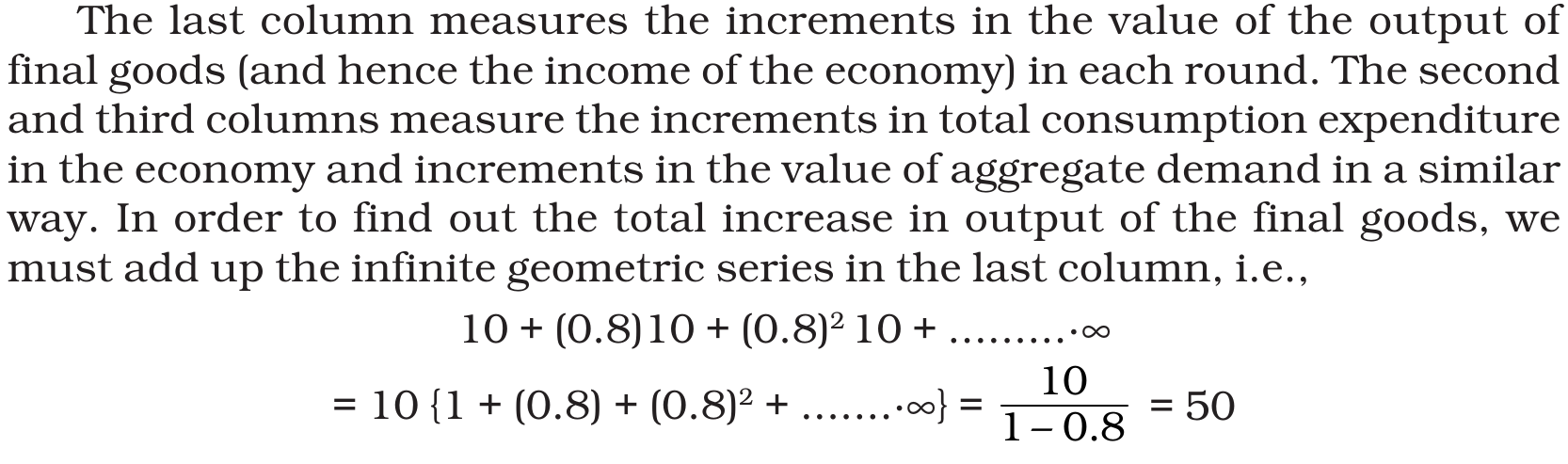
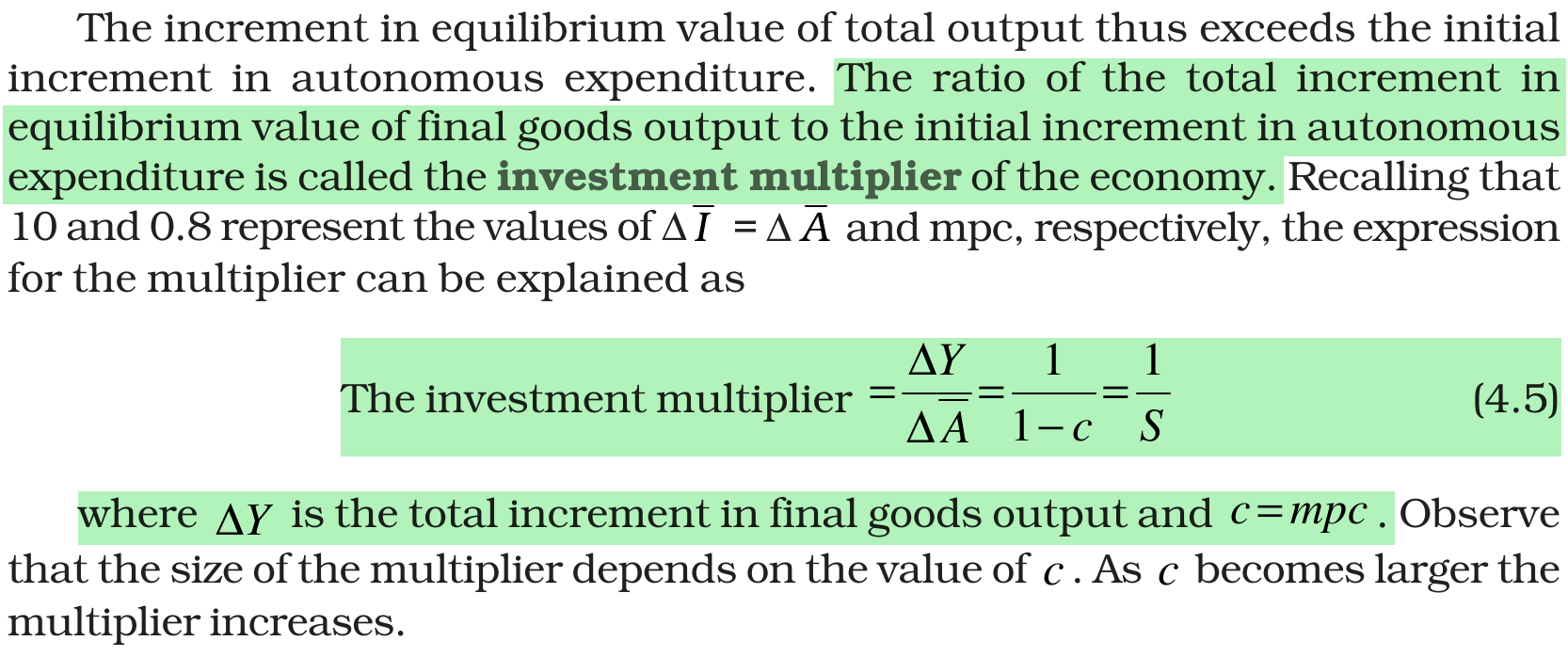
The investment multiplier (k) is linked to the MPC (marginal propensity to consume) by \( k = \frac{\Delta Y}{\Delta I} = \frac{1}{1-\text{MPC}} \). As printed, income rises by \( \Delta I \) plus four times more:
\( \Delta Y = \Delta I + 4\Delta I = 5\Delta I \)
\( \displaystyle k = \frac{\Delta Y}{\Delta I} = 5 \)
\( \displaystyle 1 - \text{MPC} = \frac{1}{5} = 0.2 \)
MPC = 1 − 0.2 = 0.8
Taking ‘four times more than’ to mean just four times, \( k = 4 \), so \( 1 - \text{MPC} = \frac{1}{4} = 0.25 \) and MPC = 0.75, which is Option (2).
NCERT (2026-27): Introductory Macroeconomics — Chapter 4: Determination of Income and Employment
|