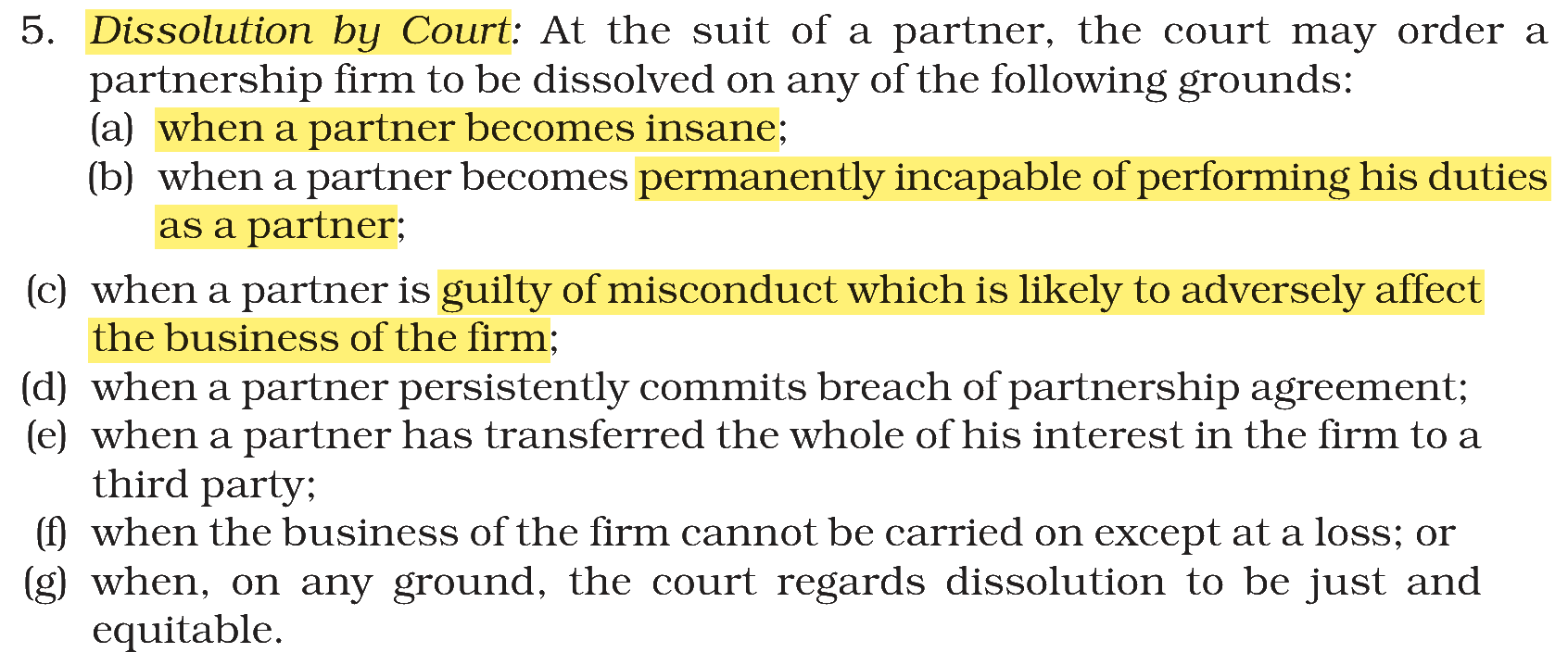
At the suit of a partner, the court may order a partnership firm to be dissolved on any of the following grounds:
(A) When a partner becomes insane.
(B) When a partner becomes permanently incapable of performing his duties as a partner.
(C) In accordance with a contract between the partners.
(D) When a partner is guilty of misconduct which is likely to adversely affect the business of the firm.
Choose the correct answer from the options given below:
Answer & explanation
Correct answer: option 2
The correct answer is Option (2) → (A), (B) and (D) only
Under dissolution by court, a partner files a suit and the court orders the firm to be dissolved on grounds laid down in the Partnership Act. Dissolution by agreement among the partners needs no court at all.
(A) When a partner becomes insane. Correct. Insanity of a partner is a ground on which the court may order dissolution, since that partner can no longer take part in the business.
(B) When a partner becomes permanently incapable of performing his duties as a partner. Correct. Permanent incapacity is a ground for dissolution by court, because the partner cannot do his part of the work again.
(C) In accordance with a contract between the partners. Incorrect. This is dissolution by agreement, not by court. The partners dissolve the firm themselves under their contract, and no suit is needed.
(D) When a partner is guilty of misconduct which is likely to adversely affect the business of the firm. Correct. Misconduct that harms the business is a ground on which the court may dissolve the firm at the suit of another partner.
NCERT (2026-27 edition):
Dissolution of a Firm – “… 1. Dissolution by Agreement: A firm is dissolved : (a) with the consent of all the partners or (b) in accordance with a contract between the partners.” |