Match List-I (authors) with List-II (their definitions of motivation):
| List-I | List-II | ||
|---|---|---|---|
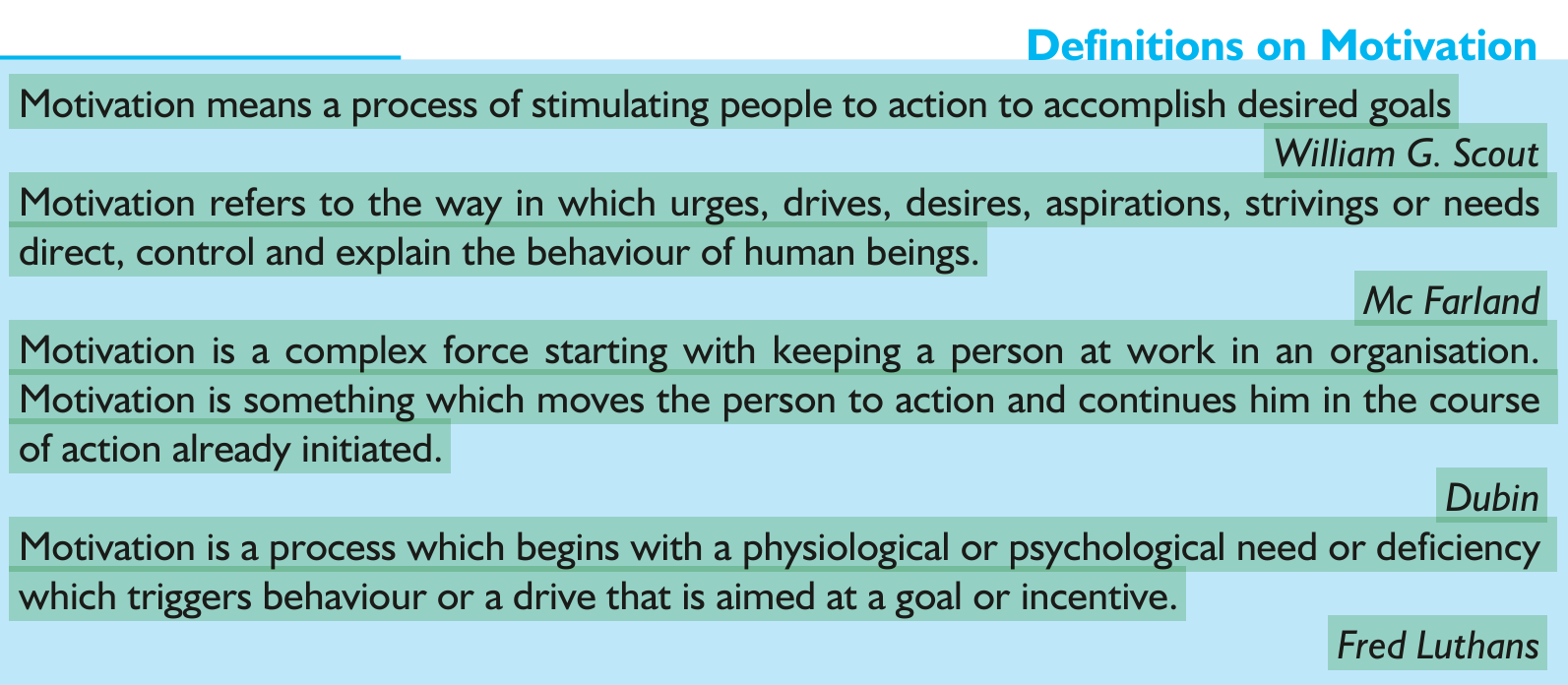
| (A) | William G. Scout | (I) | A process which begins with a physiological or psychological need or deficiency which triggers behaviour or a drive |
| (B) | Mc Farland | (II) | A process of stimulating people to action to accomplish desired goals |
| (C) | Dubin | (III) | Something which moves the person to action and continues him in the course of action already initiated |
| (D) | Fred Luthans | (IV) | The way in which urges, drives, desires, aspirations, strivings or needs direct, control and explain the behaviour of human beings |
Choose the correct answer from the options given below:
Answer & explanation
Correct answer: option 4
The correct answer is Option (4) → (A)-(II), (B)-(IV), (C)-(III), (D)-(I)
| List-I | List-II | Reason |
|---|---|---|
| (A) William G. Scout | (II) A process of stimulating people to action to accomplish desired goals | Scout calls motivation a process of stimulating people to act for desired goals. |
| (B) Mc Farland | (IV) The way in which urges, drives, desires, aspirations, strivings or needs direct, control and explain the behaviour of human beings | Mc Farland explains motivation through inner urges, drives and needs that direct behaviour. |
| (C) Dubin | (III) Something which moves the person to action and continues him in the course of action already initiated | Dubin sees motivation as a force that starts action and keeps it going. |
| (D) Fred Luthans | (I) A process which begins with a physiological or psychological need or deficiency which triggers behaviour or a drive | Luthans says motivation begins with a need or deficiency that triggers behaviour. |
NCERT (2026-27 Edition):
|