Match List I with List II
| List-I | List-II | ||
| (A) | Concept of IQ | (I) | Spearman |
| (B) | Intelligence test in Hindi | (II) | William Stern |
| (C) | Two factor theory | (III) | SM Mohsin |
| (D) | Theory of primary mental abilities | (IV) | Thurstone |
Choose the correct answer from the options given below:
Answer & explanation
Correct answer: option 3
The correct answer is Option (3) → A-II, B-III, C-I, D-IV
(A) Concept of IQ — this matches (II) William Stern. In 1912 the German psychologist William Stern devised the concept of Intelligence Quotient (IQ): mental age divided by chronological age, multiplied by 100.
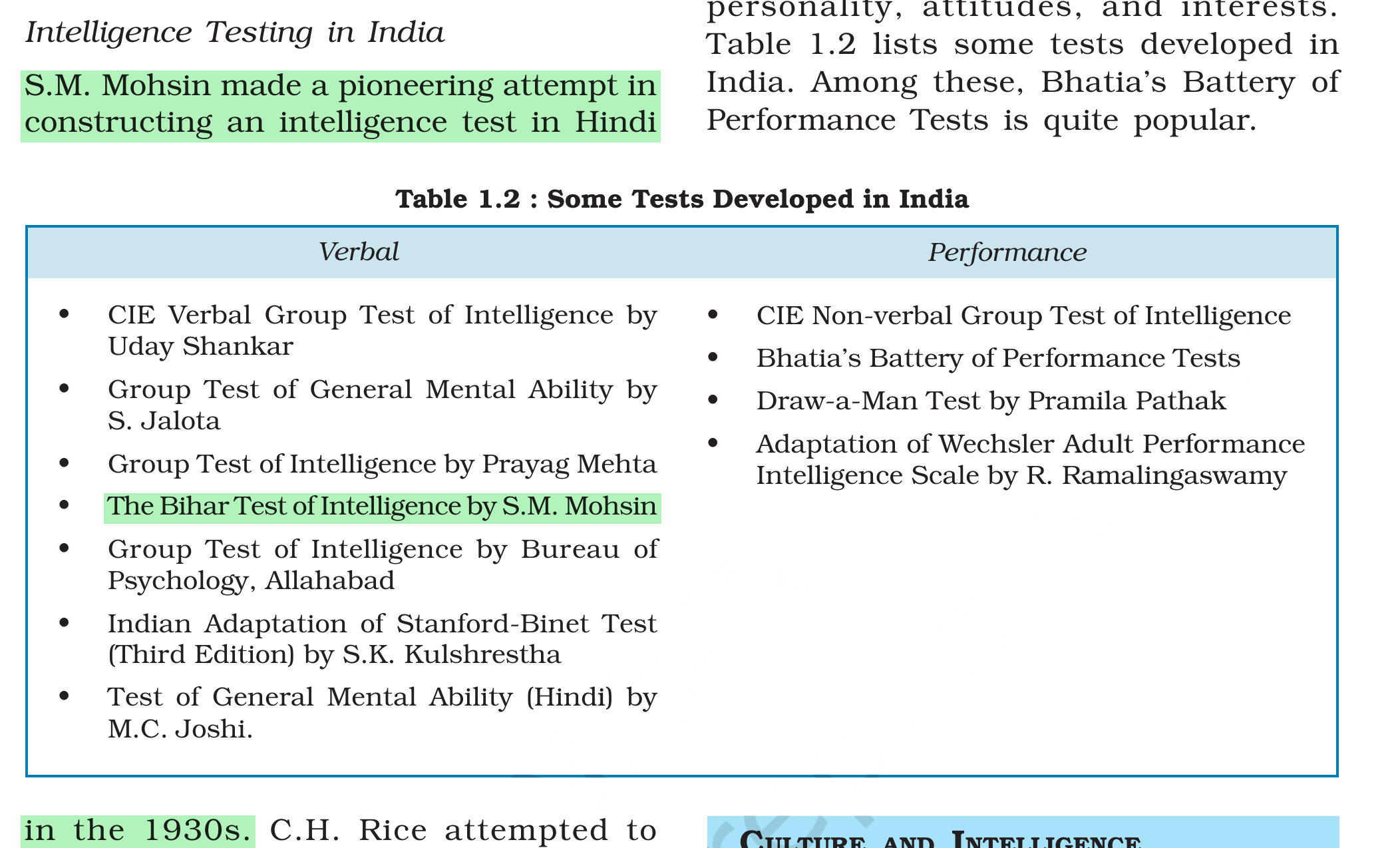
(B) Intelligence test in Hindi — this matches (III) SM Mohsin. S.M. Mohsin made a pioneering attempt in constructing an intelligence test in Hindi, in the 1930s.
(C) Two factor theory — this matches (I) Spearman. In 1927 Charles Spearman proposed a two-factor theory: intelligence consists of a general factor (g-factor) and some specific factors (s-factors).
(D) Theory of primary mental abilities — this matches (IV) Thurstone. Louis Thurstone held that intelligence consists of seven primary abilities, each relatively independent of the others, such as verbal comprehension and numerical abilities.
NCERT (2025-26): “Assessment of Intelligence … In 1912, William Stern, a German psychologist, devised the concept of Intelligence Quotient (IQ). IQ refers to mental age divided by chronological age, and multiplied by 100.…” “Theories of Intelligence … In 1927, Charles Spearman proposed a two-factor theory of intelligence employing a statistical method called factor analysis. He showed that intelligence consisted of a general factor (g-factor) and some specific factors…” “Theories of Intelligence … Spearman’s theory was followed by Louis Thurstone’s theory. He proposed the theory of primary mental abilities. It states that intelligence consists of seven primary abilities, each of which is relatively independent of the others.…”
|