
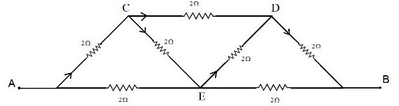
In the network shown below in the figure below, each resistance is \( 2\,\Omega \). The effective resistance between A and B would be:
Answer & explanation
Correct answer: option 2
The correct answer is Option (2) → \( \displaystyle\frac{16}{7}\,\Omega \)
The network is neither series nor parallel, so it is solved with node potentials and Kirchhoff's junction rule. From the figure, the seven resistors are AC, AE, CD, CE, ED, DB and EB, each of \( 2\,\Omega \).
Apply a potential \( V \) at A and keep B at zero. The network looks the same when it is turned round so that A and B change places (C with D, E with itself), so by symmetry
\( V_E = V/2 \)
\( V_C + V_D = V \)
Junction rule at C (all resistances equal, so the 2 cancels):
\( \displaystyle (V - V_C) + (V_D - V_C) + \left(\frac{V}{2} - V_C\right) = 0 \)
Putting \( V_D = V - V_C \):
\( \displaystyle \frac{5V}{2} = 4V_C \;\Rightarrow\; V_C = \frac{5V}{8}, \quad V_D = \frac{3V}{8} \)
The current leaving A flows through AC and AE:
\( \displaystyle I = \frac{V - \frac{5V}{8}}{2} + \frac{V - \frac{V}{2}}{2} = \frac{3V}{16} + \frac{4V}{16} = \frac{7V}{16} \)
\( \displaystyle R_{AB} = \frac{V}{I} = \frac{16}{7}\,\Omega \)
As a check, at E the currents in from C and A are \( V/16 \) and \( V/4 \), and the currents out to D and B are \( V/16 \) and \( V/4 \), so the junction rule holds.