Arrange the sequence of events resulting in depreciation of the domestic currency.
(A) The demand curve of foreign exchange will shift upwards and right to the original demand curve
(B) Suppose there is increased international traveling by Indians
(C) This means that there is increase in demand for foreign exchange
(D) This will result in an increase in the foreign exchange rate
Choose the correct answer from the options given below:
Answer & explanation
Correct answer: option 1
The correct answer is Option (1) → (B), (C), (A), (D)
The exchange rate is the price of one unit of foreign currency in rupees. When more rupees must be paid for one dollar, the rupee has depreciated.
(B) Suppose there is increased international traveling by Indians — the starting event. Indians need foreign currency to pay for their travel abroad.
(C) This means that there is increase in demand for foreign exchange — travel raises the demand for foreign goods and services, so more foreign exchange is wanted.
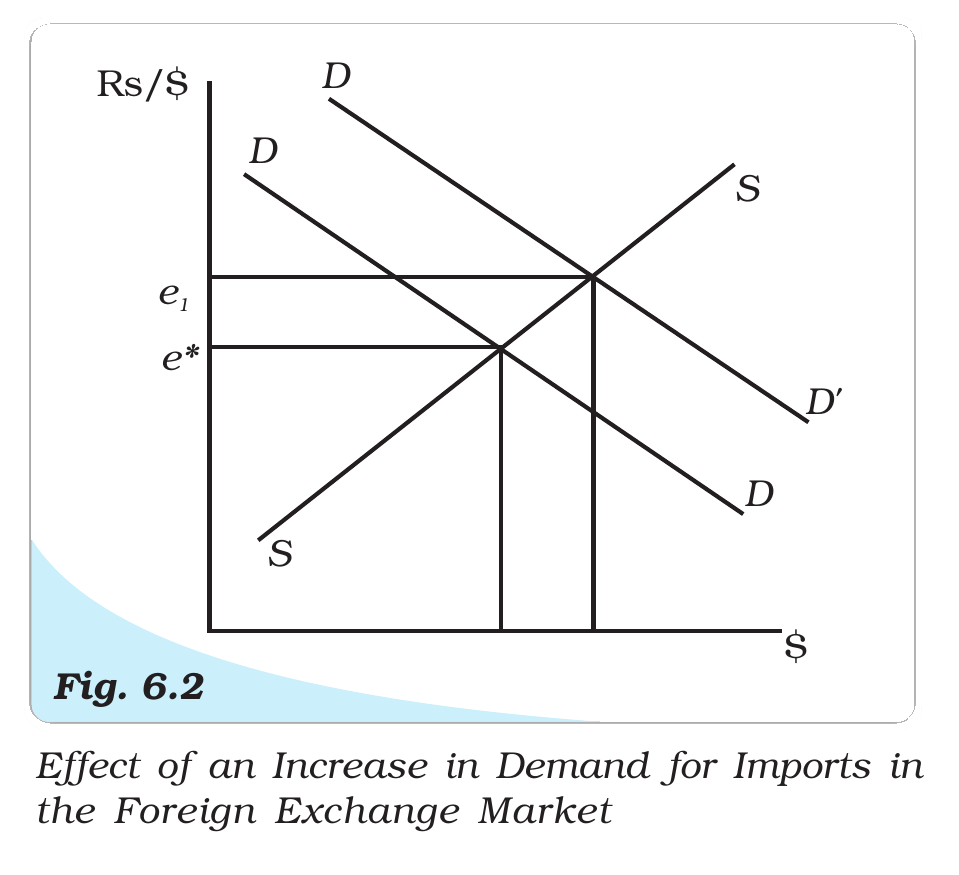
(A) The demand curve of foreign exchange will shift upwards and right to the original demand curve — more foreign exchange is now wanted at every exchange rate, so the whole demand curve shifts.
(D) This will result in an increase in the foreign exchange rate — with supply unchanged, the new demand curve meets the supply curve at a higher exchange rate. More rupees are paid for each dollar.
NCERT (2026-27): “Flexible Exchange Rate … Suppose the demand for foreign goods and services increases (for example, due to increased international travelling by Indians), then as depicted in Fig. 6.2, the demand curve shifts upward and right to the original demand curve. The increase in demand for foreign goods and services result in a change in the exchange rate. The initial exchange rate e0 = 50, which means that we need to exchange Rs 50 for one dollar. At the new equilibrium, the exchange rate becomes e1 = 70, which means that we need to pay more rupees for a dollar now (i.e., Rs 70). It indicates that the value of rupees in terms of dollars has fallen and value of dollar in terms of rupees has risen. Increase in exchange rate implies that the price of foreign currency (dollar) in terms of domestic currency (rupees) has increased. This is called Depreciation of domestic currency (rupees) in terms of foreign currency (dollars).…”
|