Identify the correct expression to calculate equilibrium level of income of an economy.
Answer & explanation
Correct answer: option 2
The correct answer is Option (2) → \( (\bar C+\bar I)/MPS \)
Equilibrium income equals autonomous expenditure, \( \bar{C} + \bar{I} \), divided by the marginal propensity to save (MPS). Autonomous expenditure is spending that does not depend on income. The MPS is the part of extra income that is saved.
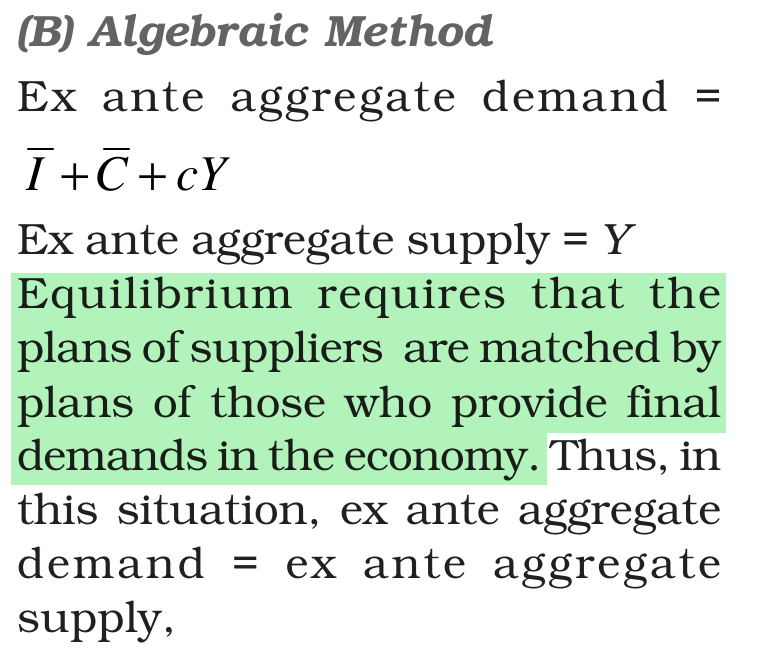
At equilibrium, output (Y) equals aggregate demand. Aggregate demand is consumption, \( \bar{C} \) + cY, plus autonomous investment, \( \bar{I} \). Here c is the marginal propensity to consume, the part of extra income that is consumed.
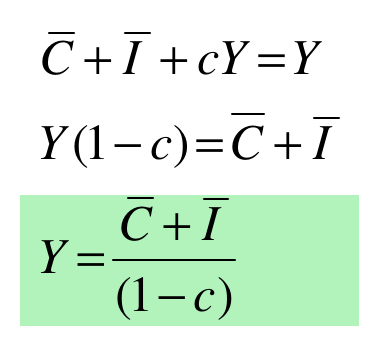
Y = \( \bar{C} \) + cY + \( \bar{I} \)
Y − cY = \( \bar{C} + \bar{I} \)
Y(1 − c) = \( \bar{C} + \bar{I} \)
\( \displaystyle Y = \frac{\bar{C} + \bar{I}}{1 - c} \)
Since 1 − c is the MPS:
\( \displaystyle Y = \frac{\bar{C} + \bar{I}}{MPS} \)
NCERT (2026-27): Introductory Macroeconomics — Chapter 4: Determination of Income and Employment
|