
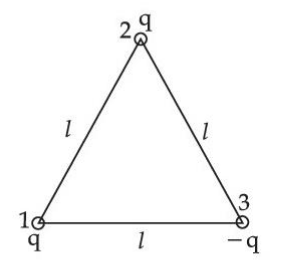
Three charges q, -q, q placed at the vertices of an equilateral triangle as shown in figure. What is the magnitude of force on charge placed at position 3 due to the presence of other two charges?
Answer & explanation
Correct answer: option 2
The correct answer is Option (2) → \( \displaystyle\frac{\sqrt{3}}{4\pi\varepsilon_0}\frac{q^{2}}{l^{2}} \)
The net force on charge 3 is the vector sum of two Coulomb forces, one from charge 1 and one from charge 2. Each of the other charges is at distance l from charge 3, and the charges have the same magnitude q, so the two forces have equal magnitude:
\( \displaystyle F_{13} = F_{23} = F = \frac{1}{4\pi\varepsilon_0}\frac{q^{2}}{l^{2}} \)
Charge 3 is \( -q \), and charges 1 and 2 are both \( +q \), so both forces are attractive. \( F_{13} \) acts along the side 3→1 and \( F_{23} \) along the side 3→2. The angle between these two sides of the equilateral triangle is \( 60^\circ \).
\( F_{\mathrm{net}} = \sqrt{F^{2} + F^{2} + 2F^{2}\cos60^\circ} = F\sqrt{3} \)
\( \displaystyle F_{\mathrm{net}} = \frac{\sqrt{3}}{4\pi\varepsilon_0}\frac{q^{2}}{l^{2}} \)
Shortcut: A force has the dimension of \( q^{2}/(\varepsilon_0 l^{2}) \), so the length must appear as \( l^{2} \) in the denominator. Options (1), (3) and (4) have \( l \) or \( \sqrt{l} \) there and fail the dimension test at once, so only Option (2) is possible.
Note: This question is from NCERT (2026-27). NTA sets numerical questions from NCERT too, so do not ignore NCERT while practising numericals.
NCERT (2026-27):
Forces Between Multiple Charges – …
