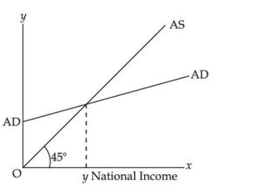
In the given figure what will happen to aggregate demand curve (AD) when autonomous investment increases.
Answer & explanation
Correct answer: option 3
The correct answer is Option (3) → AD curve shifts in parallel upwards
Aggregate demand is \( AD = C + I \), where consumption \( C = \bar{C} + cY \). Here \( \bar{C} \) is autonomous consumption and \( c \) is the marginal propensity to consume (MPC). So AD has two parts: an autonomous part \( (\bar{C} + I) \), which is the intercept on the vertical axis, and the slope c.
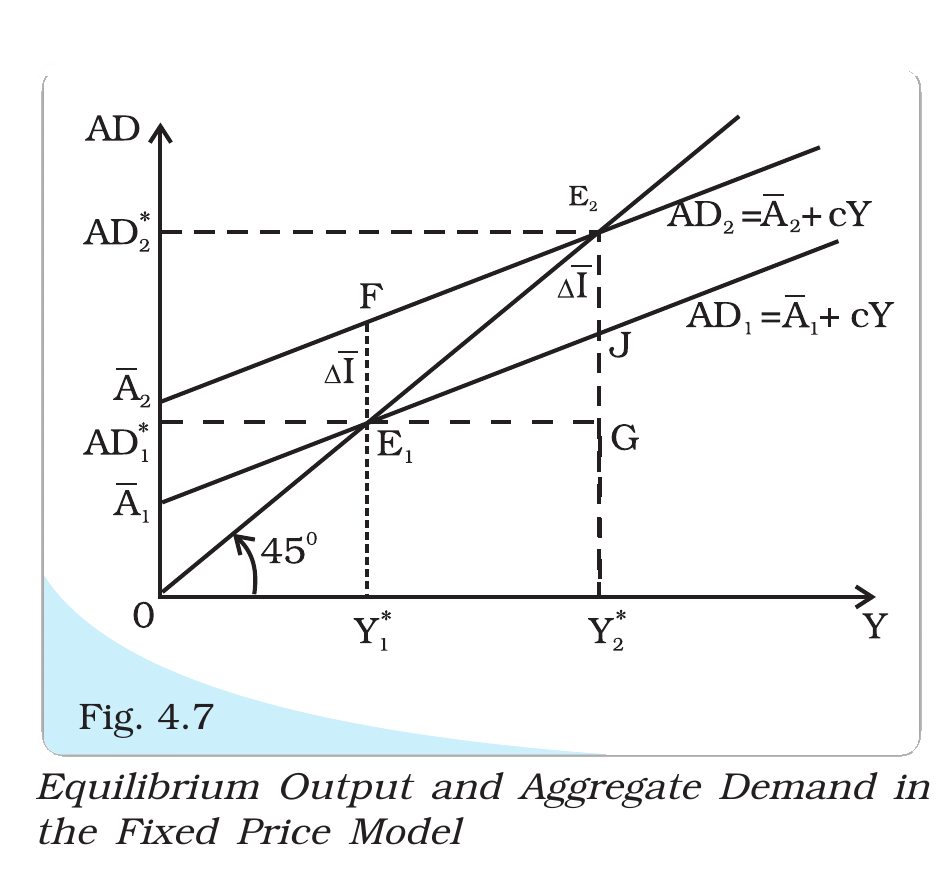
A rise in autonomous investment raises the intercept by the same amount at every level of income. The slope c does not change. So the AD line shifts upwards, parallel to the old line, and meets the 45° line at a higher income.
A shift that is not parallel would need a change in the slope, that is, a change in the MPC.
NCERT (2026-27): “4.3.2 Effect of an Autonomous Change in Aggregate Demand on Income and Output We have seen that the equilibrium level of income depends on aggregate demand. Thus, if aggregate demand changes, the equilibrium level of income changes. … When autonomous investment increases, the AD1 line shifts in parallel upwards and assumes the position AD2.… …When A̅ changes the line shifts upwards or downwards in parallel. When c changes, however, the line swings up or down.…”
|