In RNA interference method, nematode specific genes were introduced into the host plant which produce _________.
Answer & explanation
Correct answer: option 3
The correct answer is Option (3) → both sense and antisense strands of RNA in the host
Option (1) only sense strand of RNA in the host — Incorrect. If only the sense strand were made, no double-stranded RNA could form. RNAi needs dsRNA, so the introduced DNA must give both strands, sense and antisense.
Option (2) only antisense strand of RNA in the host — Incorrect. The antisense strand alone cannot give dsRNA. Both the sense and antisense RNA are produced, and they pair to form the dsRNA that silences the nematode’s mRNA.
Option (3) both sense and antisense strands of RNA in the host — Correct. Both strands were needed because only complementary sense and antisense RNA can pair to form dsRNA. This dsRNA starts RNAi and silences the nematode’s mRNA, so the parasite cannot survive in the plant.
Option (4) dsDNA for cellular defense — Incorrect. RNA interference works through dsRNA, not dsDNA. The introduced genes are transcribed into complementary RNA strands, which pair to form the dsRNA.
NCERT Extract:
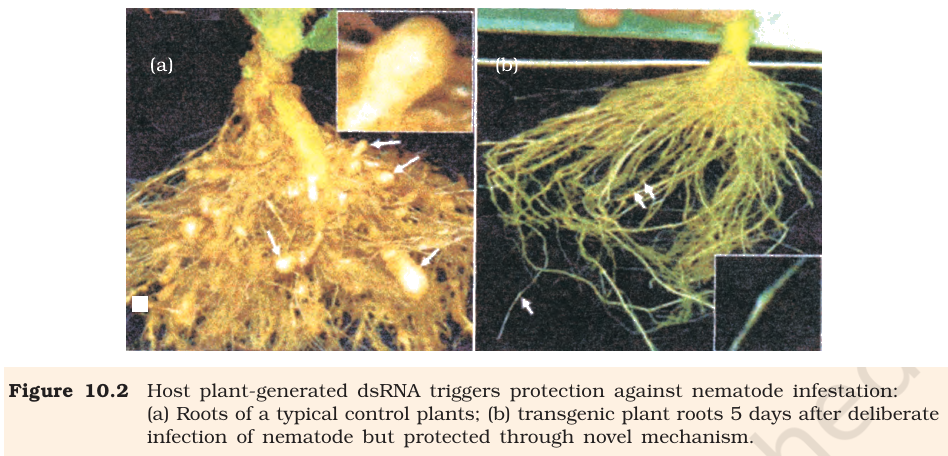
Biotechnological Applications in Agriculture – “… Using Agrobacterium vectors, nematode-specific genes were introduced into the host plant (Figure 10.2). The introduction of DNA was such that it produced both sense and anti-sense RNA in the host cells. These two RNA’s being complementary to each other formed a double stranded (dsRNA) that initiated RNAi and thus, silenced the specific mRNA of the nematode.”