CUETMOCK
  • Pricing
  • Mentors
Log inStart freeStart free mocks→

First test, then trust

Try a free CUET mock test.

Join 5,00,000+ students who rehearsed exam day on the exact NTA screen before sitting CUET. On the web and on Android.

Start free mocks →Get the Android app
CUETMOCK

India's #1 CUET Mock Test Platform. Original NCERT-based questions on the exact NTA exam screen — trusted by 5,00,000+ students since CUET 2022.

Get it onGoogle PlayScan to download the CUETMOCK app

Mock tests

  • CUET mock test series
  • Commerce mocks
  • Humanities (Arts) mocks
  • Science mocks
  • Languages & GAT mocks
  • Free practice questions
  • Pricing

Resources

  • CUET exam guide
  • CUET syllabus
  • Universities accepting CUET
  • Expert blogs
  • News & notifications
  • Webinars & counselling
  • CUET score calculator
  • How we estimate your rank
  • FAQs

Company

  • About us
  • Our leadership & team
  • Our toppers
  • Mentors
  • For schools
  • Contact us
  • Terms
  • Privacy
  • Refund policy

Talk to us

+91 7696 6630 56info@cuetmock.comWhatsApp us

Our other platforms

  • JEE Mock — For IIT-JEE aspirants
  • NEET Mock — For NEET aspirants

Newsletter

Exam updates, study material and offers — no spam.

© 2026 NYC Ventures Pvt. Ltd.

701-702, Royal Business Park, Zirakpur, Punjab - 140603

  • Terms of use
  • Privacy policy
  • Refund policy
  • Contact us

iCUETMOCK is an independent preparation platform, not affiliated with the National Testing Agency (NTA). Always check exam details on the official NTA website.

  • Home
  • Mock tests
  • CUET guide
  • Pricing
  • Log in
Home/Practice questions/History
HistoryMedieval India: Peasants, Zamindars and the State

Which of the following land was most fertile?

Read the passage and answer the questions:

Classification of Land under Akbar

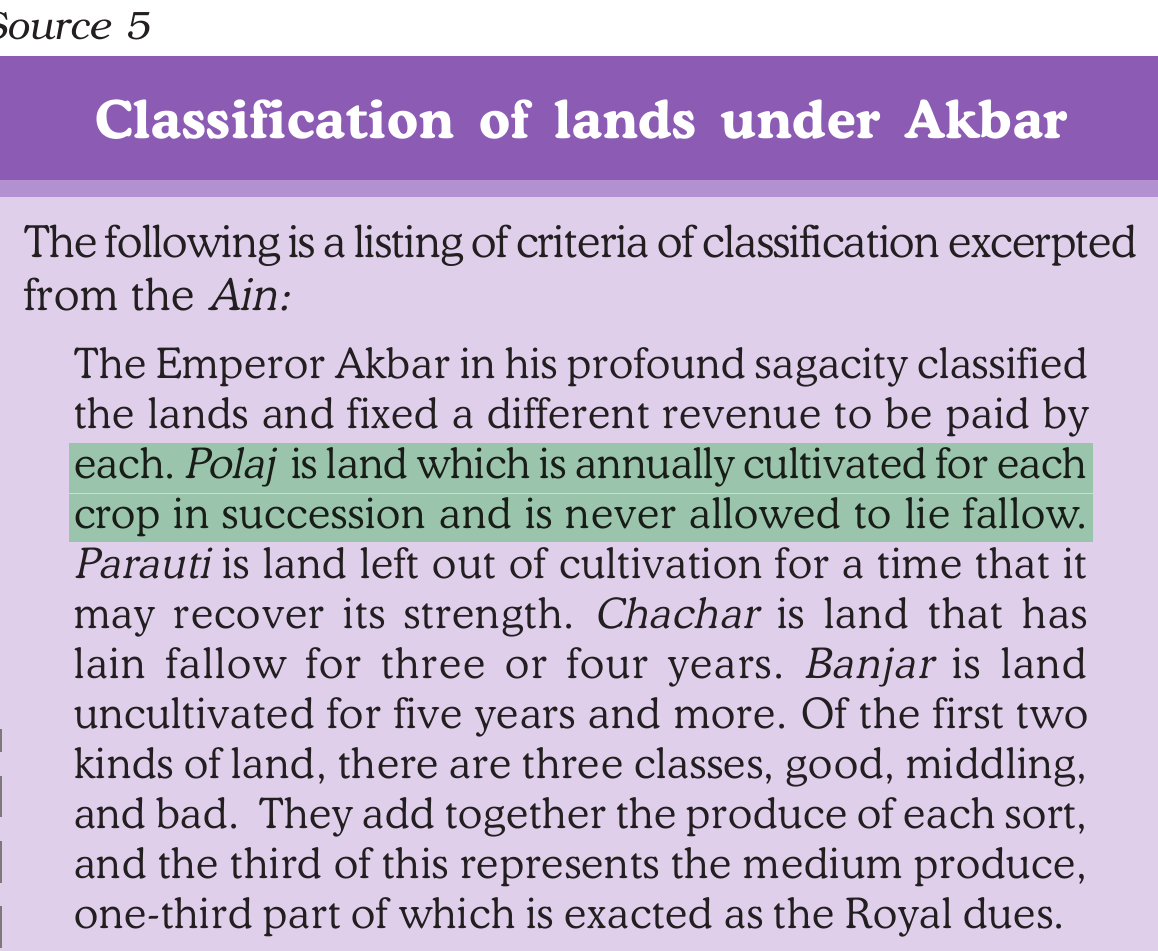
The following is a listing of criteria of classification excerpted from the Ain: The Emperor Akbar in his profound sagacity classified the lands and fixed a different revenue to be paid by each. Polaj is land which is annually cultivated for each crop in succession and is never allowed to lie fallow. Parauti is land left out of cultivation for a time that it may recover its strength. Chachar is land that has lain fallow for three or four years. Banjar is land uncultivated for five years and more. Of the first two kinds of land, there are three classes, good, middling, and bad. They add together the produce of each sort, and the third of this represents the medium produce, one-third part of which is exacted as the Royal dues. Revenue from the land was the economic mainstay of the Mughal Empire. It was therefore vital for the state to create an administrative apparatus to ensure control over agricultural production, and to fix and collect revenue from across the length and breadth of the rapidly expanding empire. This apparatus included the office (daftar)…, responsible for supervising the fiscal system of the empire. Thus revenue officials and record keepers penetrated the agricultural domain and became a decisive agent in shaping agrarian relations.

Which of the following land was most fertile?

Answer & explanation+

Correct answer: option 2

The correct answer is Option (2) → Polaj

Akbar classified the lands and fixed a different revenue for each kind. Polaj was land cultivated every year for each crop in succession and never allowed to lie fallow, so it was the most fertile and most regularly used. Parauti was left out of cultivation for a time to recover its strength, chachar had lain fallow for three or four years, and banjar had been uncultivated for five years or more.

Note: This passage is taken from the NCERT chapter ‘Peasants, Zamindars and the State’: the extract from the Ain on the classification of lands, followed by the paragraph on the land revenue system. Sources quoted inside a chapter, like this one from the Ain, are as much a part of the syllabus as the chapter’s own words.


NCERT: Themes in Indian History Part II — Chapter 8: Peasants, Zamindars and the State (2025-26)

NCERT extract

Advertisement

Practise more on Medieval India: Peasants, Zamindars and the State

Chapter-wise mocks on the real NTA exam screen, with solutions and your rank. Your first mocks are free.

Start free mocks →

Advertisement

Next questions

  1. Match the words given in List-I with the meanings given in List-II.List-I (Words)List-II (Meanings)(A) Garret(I) A large tank or building w…English · One Word
  2. 'वह पहुँचा ही होगा।' — इस वाक्य में क्रिया का काल कौन-सा है?Hindi · काल
  3. Choose the most appropriate synonym of the underlined word.Over a hundred MPs signed a notice to impeach the High Court judge after serious…English · Synonyms
  4. Choose the most appropriate words from the options given below to fill in the blank in the following sentence:-The thief was --- with a sma…English · Grammar: Phrasal Verb
  5. Which of the following is not correct about tea cultivation?General Aptitude Test · General Knowledge
  6. व्यंजन संधि के उदाहरण हैं -(A) सम्मान(B) जगदंबा(C) नीरव(D) अत्युक्ति(E) सद्भावनानीचे दिए गए विकल्पों में से सही उत्तर चुनें :Hindi · संधि
  7. Choose the figure which is different from the other three.General Aptitude Test · Non-Verbal Reasoning
  8. निम्नलिखित में से 'भोला' का विलोम शब्द क्या होगा?Hindi · विलोम शब्द
  9. Which one of the following is a palindromic sequence?Biology · Biotechnology -Principles and Processes
  10. Ulothrix, Chara and Spirogyra are simple plants without a well-differentiated body. In which division are they placed?General Aptitude Test · General Knowledge