
Match List-I with List-II
| List-I REACTIONS | List-II PRODUCTS |
| (A) C6H5NH2 + (CH3CO)2O in pyridine | (I) C6H5N2+Cl– + NaCl + 2H2O |
| (B) C6H5N2+Cl– + C6H5OH + OH– | (II) C6H5NHCOCH3 + CH3COOH |
(C) 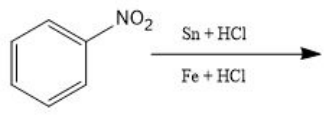 | (III)  |
| (D) C6H5NH2 + NaNO2 + 2HCl \( \xrightarrow{\text{273-278K}} \) | (IV) 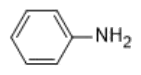 |
Choose the correct answer from the options given below:
Answer & explanation
Correct answer: option 4
The correct answer is Option (4) → (A) - (II), (B) - (III), (C) - (IV), (D) - (I)
All four are standard reactions of aniline and its derivatives: acylation of the –\( \ce{NH2} \) group, preparation of aniline by reduction, conversion of aniline into a diazonium salt, and coupling of that salt with phenol:
(A) \( \ce{C6H5NH2} \) + \( \ce{(CH3CO)2O} \) in pyridine — This matches (II) C6H5NHCOCH3 + CH3COOH. This is acetylation: the acetyl group replaces a hydrogen of –\( \ce{NH2} \) to give acetanilide. Pyridine, a base stronger than aniline, removes the acid formed and shifts the equilibrium to the right.
\( \displaystyle \ce{C6H5NH2 + (CH3CO)2O} \xrightarrow{\text{pyridine}} \ce{C6H5NHCOCH3 + CH3COOH} \)
(B) C6H5N2+Cl– + \( \ce{C6H5OH} \) + OH– — This matches structure (III). This is a coupling reaction: in mildly alkaline medium the diazonium ion attacks the para position of the phenoxide ion and gives orange p-hydroxyazobenzene.
\( \displaystyle \ce{C6H5N2^+Cl^- + C6H5OH + OH^- -> C6H5-N=N-C6H4-OH + Cl^- + H2O} \)
(C) Nitrobenzene with Sn + HCl or Fe + HCl — This matches structure (IV). The metal and acid reduce the nitro group to an amino group and give aniline. Fe and HCl is preferred, because the \( \ce{FeCl2} \) formed is hydrolysed and releases HCl, so only a small amount of acid is needed.
\( \displaystyle \ce{C6H5NO2 + 3Sn + 6HCl} \xrightarrow{\text{heat}} \ce{C6H5NH2 + 3SnCl2 + 2H2O} \)
\( \displaystyle \ce{C6H5NO2 + 3Fe + 6HCl} \xrightarrow{\text{heat}} \ce{C6H5NH2 + 3FeCl2 + 2H2O} \)
(D) \( \ce{C6H5NH2} \) + \( \ce{NaNO2} \) + 2HCl (273–278 K) — This matches (I) C6H5N2+Cl– + NaCl + 2H2O. This is diazotisation: nitrous acid formed from \( \ce{NaNO2} \) and HCl converts the primary aromatic amine into benzenediazonium chloride. The mixture is kept cold because the diazonium salt decomposes on warming.
\( \displaystyle \ce{C6H5NH2 + NaNO2 + 2HCl} \xrightarrow{\text{273-278 K}} \ce{C6H5N2^+Cl^- + NaCl + 2H2O} \)
Shortcut: The pair (A)–(II) appears only in Option (4).