
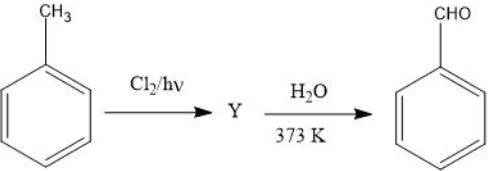
Identify the intermediate (Y) in the following reaction for the commercial method of manufacturing of benzaldehyde?
Answer & explanation
Correct answer: option 2
The correct answer is Option (2) → benzal chloride (\( \ce{C6H5CHCl2} \))
In the commercial method, benzaldehyde is made from toluene by side chain chlorination followed by hydrolysis. Chlorine in sunlight (or UV light) does not attack the ring; it substitutes the hydrogen atoms of the methyl group by a free radical reaction. Two hydrogens are replaced to give benzal chloride:
\( \displaystyle \ce{C6H5CH3 + 2Cl2} \xrightarrow{h\nu} \ce{C6H5CHCl2 + 2HCl} \)
On heating with water at 373 K, the two chlorine atoms on the same carbon are replaced by –OH groups. This gem-diol is unstable and loses water to give the aldehyde:
\( \displaystyle \ce{C6H5CHCl2 + H2O} \xrightarrow{\text{373 K}} \ce{C6H5CHO + 2HCl} \)
So the intermediate Y is benzal chloride.
Why the other options are incorrect
Option (1) the chromium complex \( \ce{C6H5CH(OCrOHCl2)2} \) — Incorrect. This is the intermediate of the Etard reaction, where toluene is oxidised by chromyl chloride, \( \ce{CrO2Cl2} \), in \( \ce{CS2} \); it is not formed with \( \ce{Cl2} \)/hν.
Option (3) benzyl chloride (\( \ce{C6H5CH2Cl} \)) — Incorrect. It has only one chlorine on the side chain; its hydrolysis gives benzyl alcohol, \( \ce{C6H5CH2OH} \), not benzaldehyde.
Option (4) benzoic acid (\( \ce{C6H5COOH} \)) — Incorrect. This is the product of complete chlorination (\( \ce{C6H5CCl3} \)) followed by hydrolysis, or of oxidation of toluene with \( \ce{KMnO4} \); it is not the intermediate.
NCERT (2026-27 edition):
By Side Chain Chlorination Followed by Hydrolysis
