CUETMOCK
  • Pricing
  • Mentors
Log inStart freeStart free mocks→

First test, then trust

Try a free CUET mock test.

Join 5,00,000+ students who rehearsed exam day on the exact NTA screen before sitting CUET. On the web and on Android.

Start free mocks →Get the Android app
CUETMOCK

India's #1 CUET Mock Test Platform. Original NCERT-based questions on the exact NTA exam screen — trusted by 5,00,000+ students since CUET 2022.

Get it onGoogle PlayScan to download the CUETMOCK app

Mock tests

  • CUET mock test series
  • Browse all papers
  • Commerce mocks
  • Humanities (Arts) mocks
  • Science mocks
  • Languages & GAT mocks
  • Free practice questions
  • Pricing

Resources

  • CUET exam guide
  • CUET syllabus
  • Universities accepting CUET
  • Expert blogs
  • News & notifications
  • Webinars & counselling
  • CUET score calculator
  • How we estimate your rank
  • FAQs

Company

  • About us
  • Our leadership & team
  • Our toppers
  • Mentors
  • For schools
  • Contact us
  • Terms
  • Privacy
  • Refund policy

Talk to us

+91 7696 6630 56info@cuetmock.comWhatsApp us

Our other platforms

  • JEE Mock — For IIT-JEE aspirants
  • NEET Mock — For NEET aspirants

Newsletter

Exam updates, study material and offers — no spam.

© 2026 NYC Ventures Pvt. Ltd.

701-702, Royal Business Park, Zirakpur, Punjab - 140603

  • Terms of use
  • Privacy policy
  • Refund policy
  • Contact us

iCUETMOCK is an independent preparation platform, not affiliated with the National Testing Agency (NTA). Always check exam details on the official NTA website.

  • Home
  • Mock tests
  • CUET guide
  • Pricing
  • Log in
Home/Practice questions/Economics
EconomicsMacro Economics: Open Economy Macro Economics

In September 1975, the Indian rupee was delinked from Britain's pound…

Exchange Rate Management : The Indian Experience

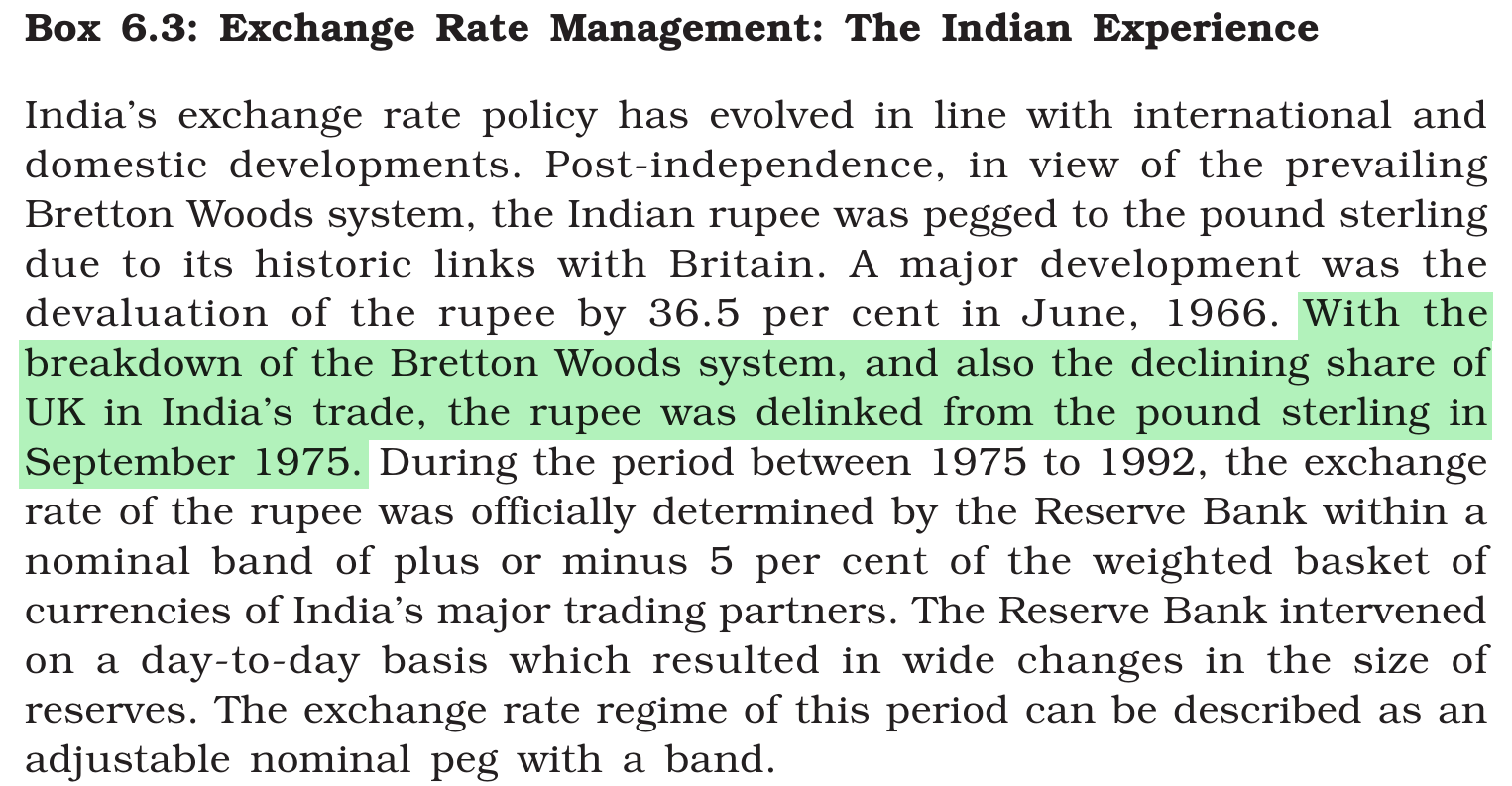
India's exchange rate policy has evolved in line with international and domestic developments. Post-independence, in view of the prevailing Bretton Woods system, the Indian rupee was pegged to the pound sterling due to its historic links with Britain. A major development was the devaluation of the rupee by 36.5 per cent in June 1966. With the breakdown of the Bretton Woods system, and also the declining share of UK in India's trade the rupee was delinked from the pound sterling in September 1975. During the period between 1975 to 1992, the exchange rate of the rupee was officially determined by the Reserve Bank within a nominal band of plus or minus 5 per cent of the weighted basket of currencies of India's major trading partners. The Reserve Bank intervened on a day-to-day basis which resulted in wide changes in the size of reserves. The exchange rate regime of this period can be described as an adjustable nominal peg with a band.

The beginning of 1990s saw significant rise in oil prices and suspension of remittances from the Gulf region in the wake of the Gulf crisis. This and other domestic and International developments, led to severe balance of payments problems in India. The drying up of access to commercial banks and short-term credit made financing the current account deficit difficult. India's foreign currency reserves fell rapidly from US $ 3.1 billion in August to US $ 975 million on July 12, 1991.

In September 1975, the Indian rupee was delinked from Britain's pound sterling due to:

Answer & explanation+

Correct answer: option 2

The correct answer is Option (2) → Decline in India’s Trade with United Kingdom

The rupee was delinked because of the declining share of the UK in India’s trade. The Bretton Woods system had also broken down by then.

A currency is usually tied to the currency of a country it trades with a lot. As Britain’s share in India’s trade fell, the pound mattered less to India. So from 1975 the RBI fixed the rupee’s value against a basket of currencies of India’s major trading partners instead.

Note: The passage of this question is taken from the box ‘Exchange Rate Management: The Indian Experience’ of the chapter ‘Open Economy Macroeconomics’. The box was there in the pre-rationalised NCERT. This portion has been deleted from subsequent editions of NCERT, including the NCERT book (2026-27), though the chapter is still there.

NCERT (Pre-rationalised): Introductory Macroeconomics — Chapter 6: Open Economy Macroeconomics

NCERT extract

Advertisement

Practise more on Macro Economics: Open Economy Macro Economics

Chapter-wise mocks on the real NTA exam screen, with solutions and your rank. Your first mocks are free.

Start free mocks →

Advertisement

Next questions

  1. The price elasticity of demand for a good is 2 and its price changes by 5%. What will be the percentage change in its quantity demanded?Economics · Micro Economics: Theory of Consumer behaviour
  2. Match the Column I with Column II : Column I (Biomedical techniques) Column II(Features) A. Computed tomography 1. A piece of the suspected…Biology · Human Health and Disease
  3. Match List-I with List-II List-I Solute List-II van't Hoff factor, i (A) Benzoic acid in benzene (I) 3 (B) K_2SO_4 (aq) (II) 2 (C) Urea (aq…Chemistry · Physical: Solutions
  4. Choose the correct pair of words to fill in the blanks: Usually, such movies don't _________ me but this particular movie had an odd ______…English · Homonyms
  5. Which of the following is a crop of Rabi season?General Aptitude Test · General Knowledge
  6. The First decade of Indian Politics was described as the ‘Congress System’ because:Political Science · Politics in India Since Independence: Era of one Party Dominance
  7. Which principle of Fayol does the passage describe as a good practice in Mr. Raju’s company?Business Studies · Principles of Management
  8. In Indian nationalism,the term "inclusive" in the context of Indian nationalism refers to the recognition of which of the following?Sociology · Indian Society: Challenges of Cultural Diversity
  9. निम्नलिखित में से किन लोकोक्तियों के आगे उनका सही अर्थ दिया गया है?(A) 'दैव-दैव आलसी पुकारा' - आलसी व्यक्ति भाग्य के भरोसे रहता है(B) 'तेल…Hindi · लोकोक्तियाँ
  10. Rashmi went to Paris with her school dance group for an Indian dance performance. After the dance show was over, many people approached her…Entrepreneurship · Entrepreneurial Opportunity