CUETMOCK
  • Pricing
  • Mentors
Log inStart freeStart free mocks→

First test, then trust

Try a free CUET mock test.

Join 5,00,000+ students who rehearsed exam day on the exact NTA screen before sitting CUET. On the web and on Android.

Start free mocks →Get the Android app
CUETMOCK

India's #1 CUET Mock Test Platform. Original NCERT-based questions on the exact NTA exam screen — trusted by 5,00,000+ students since CUET 2022.

Get it onGoogle PlayScan to download the CUETMOCK app

Mock tests

  • CUET mock test series
  • Browse all papers
  • Commerce mocks
  • Humanities (Arts) mocks
  • Science mocks
  • Languages & GAT mocks
  • Free practice questions
  • Pricing

Resources

  • CUET exam guide
  • CUET syllabus
  • Universities accepting CUET
  • Expert blogs
  • News & notifications
  • Webinars & counselling
  • CUET score calculator
  • How we estimate your rank
  • FAQs

Company

  • About us
  • Our leadership & team
  • Our toppers
  • Mentors
  • For schools
  • Contact us
  • Terms
  • Privacy
  • Refund policy

Talk to us

+91 7696 6630 56info@cuetmock.comWhatsApp us

Our other platforms

  • JEE Mock — For IIT-JEE aspirants
  • NEET Mock — For NEET aspirants

Newsletter

Exam updates, study material and offers — no spam.

© 2026 NYC Ventures Pvt. Ltd.

701-702, Royal Business Park, Zirakpur, Punjab - 140603

  • Terms of use
  • Privacy policy
  • Refund policy
  • Contact us

iCUETMOCK is an independent preparation platform, not affiliated with the National Testing Agency (NTA). Always check exam details on the official NTA website.

  • Home
  • Mock tests
  • CUET guide
  • Pricing
  • Log in
Home/Practice questions/History
HistoryAncient India: Kings, Farmers and Towns

Identify the statements which are True: A. Megasthenes was a Greek am…

Identify the statements which are True:

A. Megasthenes was a Greek ambassador to Samudra Gupta.
B. Cholas and Pandyas were in North India.
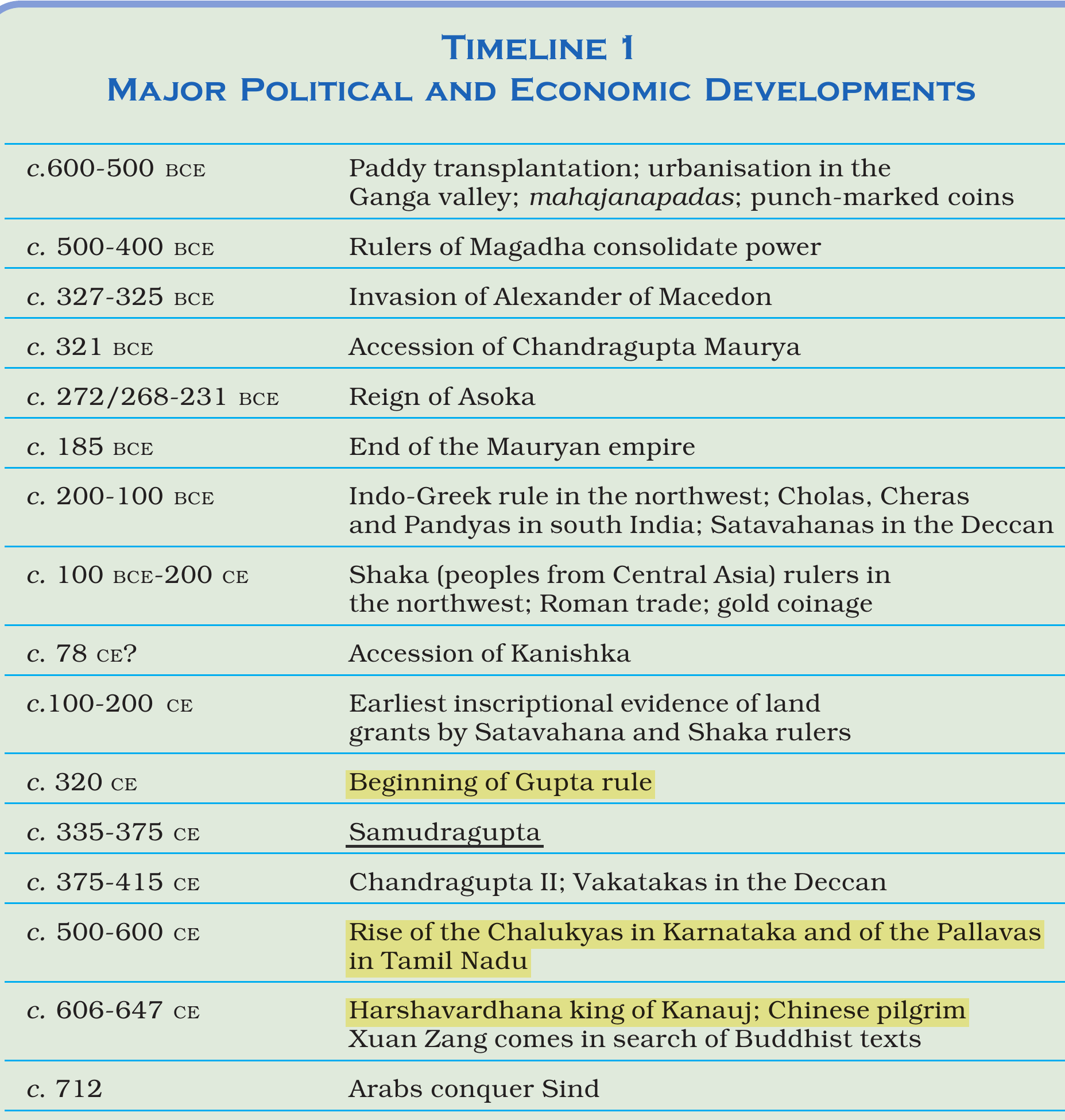
C. Rise of Pallavas in Tamil Nadu.
D. Harshvardhana was king of Kanauj.
E. The Gupta rule began in 320 C.E.

Choose the correct answer from the options given below:

Answer & explanation+

Correct answer: option 3

The correct answer is Option (3) → C, D, E only

A. Megasthenes was a Greek ambassador to Samudra Gupta. Incorrect. Megasthenes was a Greek ambassador to the court of Chandragupta Maurya, and his account survives in fragments. Samudragupta ruled much later, in c. 335-375 CE.

B. Cholas and Pandyas were in North India. Incorrect. The chiefdoms of the Cholas, Cheras and Pandyas were in Tamilakam, the ancient Tamil country in the south, which included parts of present-day Andhra Pradesh and Kerala besides Tamil Nadu.

C. Rise of Pallavas in Tamil Nadu. Correct. The rise of the Pallavas in Tamil Nadu, along with that of the Chalukyas in Karnataka, took place in c. 500-600 CE.

D. Harshvardhana was king of Kanauj. Correct. Harshavardhana was king of Kanauj in c. 606-647 CE; his biography, the Harshacharita, was composed in Sanskrit by his court poet Banabhatta.

E. The Gupta rule began in 320 C.E. Correct. The timeline gives c. 320 CE as the beginning of Gupta rule.


NCERT (2026-27): “3.1 Finding out about the Mauryas … Historians have used a variety of sources to reconstruct the history of the Mauryan Empire. These include archaeological finds, especially sculpture. Also valuable are contemporary works, such as the account of Megasthenes (a Greek ambassador to the court of Chandragupta Maurya), which survives in fragments. Another source that is often used is the Arthashastra, parts of which were probably composed by Kautilya or Chanakya, traditionally believed to be the minister of Chandragupta.…

4.1 Chiefs and kings in the south … The new kingdoms that emerged in the Deccan and further south, including the chiefdoms of the Cholas, Cheras and Pandyas in Tamilakam (the name of the ancient Tamil country, which included parts of present-day Andhra Pradesh and Kerala, in addition to Tamil Nadu), proved to be stable and prosperous.

…The Harshacharita is a biography of Harshavardhana, the ruler of Kanauj …, composed in Sanskrit by his court poet, Banabhatta (c. seventh century CE ).…”

NCERT extract

Advertisement

Practise more on Ancient India: Kings, Farmers and Towns

Chapter-wise mocks on the real NTA exam screen, with solutions and your rank. Your first mocks are free.

Start free mocks →

Advertisement

Next questions

  1. In the single slit experiment of diffraction, the aperture of the slit is 2 mm. If a monochromatic light of wavelength 600 nm is incident n…Physics · Wave Optics
  2. How will the current through a conductor vary if the potential difference across its ends is made to double its value?Physics · Current Electricity
  3. मलिक मुहम्मद जायसी भक्तिकाल की किस शाखा के कवि हैं?Hindi · हिंदी साहित्य (रचना, रचनाकार और विधाएँ)
  4. Match List I with List II. Match the events in List I with their year of occurrence in List II LIST-I(Events)LIST-II(Year of occurrence)A.J…Sociology · Social Change and Development in India: Structural Change
  5. The area bounded by the curve y^2=2x and the lines y=2,y=4 and y -axis, isMaths. Section B1 · Application of Integrals
  6. The year wise production of a company (in tonnes) is given in the following table. Year Production (in tonnes) 2001-02 790 2002-03 810 2003…General Aptitude Test · Quantitative Reasoning
  7. The colour of coordination compounds is attributed toChemistry · Inorganic: Coordination Compounds
  8. What adornments are mentioned in Paes's description of the lower platform of the "House of Victory"?History · Medieval India: An Imperial Capital: Vijayanagara
  9. 'वह अगले साल आएगा' - इस वाक्य में 'अगले साल' में कौन-सा कारक है?Hindi · कारक
  10. On selling a watch at 4/5 of the marked price there is a loss of 10 percent. What will be the ratio of the marked price and cost price of t…General Aptitude Test · Numerical Ability