CUETMOCK
  • Pricing
  • Mentors
Log inStart freeStart free mocks→

First test, then trust

Try a free CUET mock test.

Join 5,00,000+ students who rehearsed exam day on the exact NTA screen before sitting CUET. On the web and on Android.

Start free mocks →Get the Android app
CUETMOCK

India's #1 CUET Mock Test Platform. Original NCERT-based questions on the exact NTA exam screen — trusted by 5,00,000+ students since CUET 2022.

Get it onGoogle PlayScan to download the CUETMOCK app

Mock tests

  • CUET mock test series
  • Browse all papers
  • Commerce mocks
  • Humanities (Arts) mocks
  • Science mocks
  • Languages & GAT mocks
  • Free practice questions
  • Pricing

Resources

  • CUET exam guide
  • CUET syllabus
  • Universities accepting CUET
  • Expert blogs
  • News & notifications
  • Webinars & counselling
  • CUET score calculator
  • How we estimate your rank
  • FAQs

Company

  • About us
  • Our leadership & team
  • Our toppers
  • Mentors
  • For schools
  • Contact us
  • Terms
  • Privacy
  • Refund policy

Talk to us

+91 7696 6630 56info@cuetmock.comWhatsApp us

Our other platforms

  • JEE Mock — For IIT-JEE aspirants
  • NEET Mock — For NEET aspirants

Newsletter

Exam updates, study material and offers — no spam.

© 2026 NYC Ventures Pvt. Ltd.

701-702, Royal Business Park, Zirakpur, Punjab - 140603

  • Terms of use
  • Privacy policy
  • Refund policy
  • Contact us

iCUETMOCK is an independent preparation platform, not affiliated with the National Testing Agency (NTA). Always check exam details on the official NTA website.

  • Home
  • Mock tests
  • CUET guide
  • Pricing
  • Log in
Home/Practice questions/History
HistoryModern India: Mahatma Gandhi and the Nationalist movement

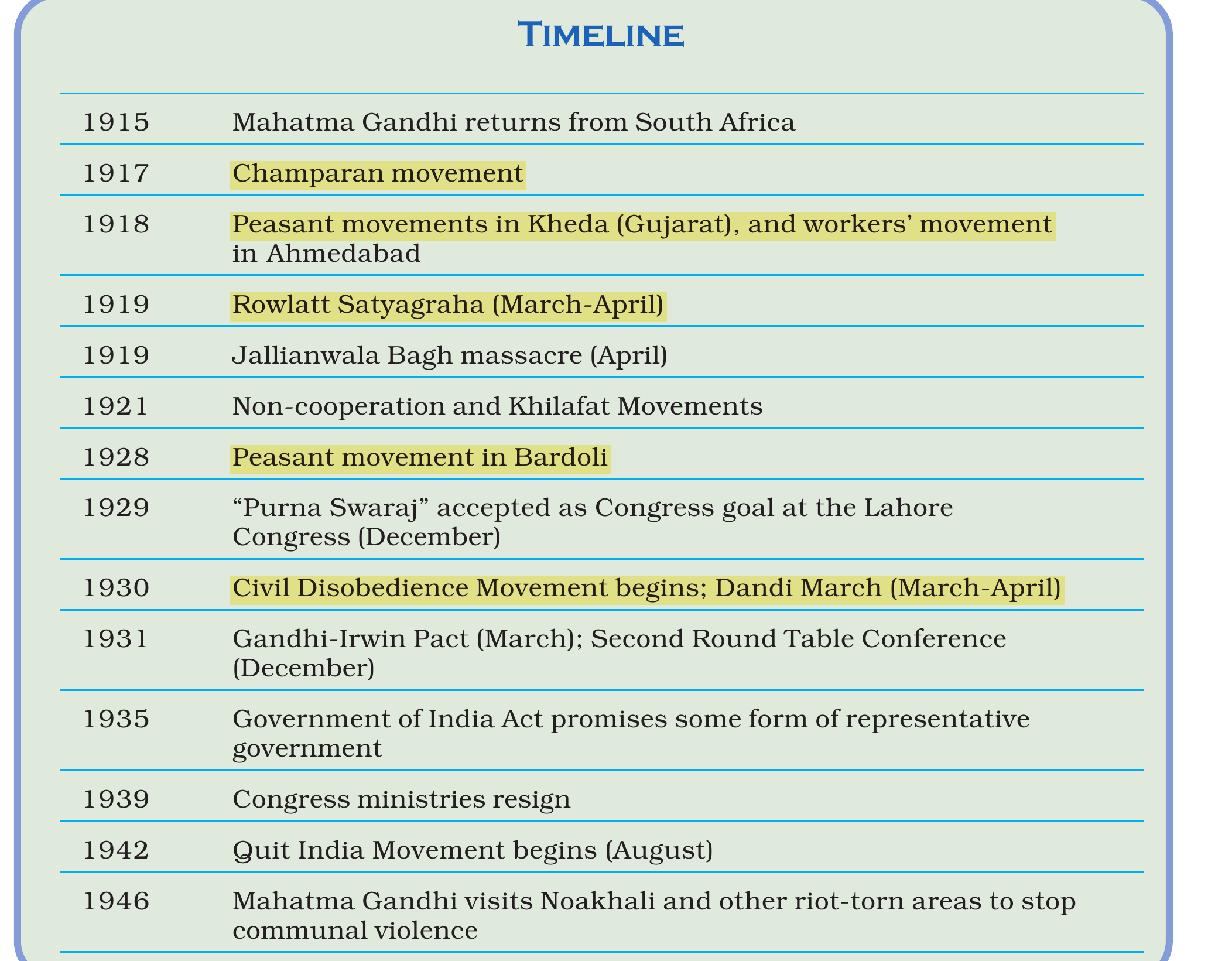
Arrange the following Gandhian movements in chronological order. A. R…

Arrange the following Gandhian movements in chronological order.

A. Rowlatt Satyagraha
B. Kheda Movement
C. Salt Satyagraha
D. Bardoli Movement
E. Champaran Movement

Choose the correct answer from the options given below:

Answer & explanation+

Correct answer: option 3

The correct answer is Option (3) → E, B, A, D, C

(E) Champaran Movement — 1917: Gandhiji spent much of that year in Champaran in Bihar, seeking security of tenure for the peasants against the indigo planters.

(B) Kheda Movement — 1918: he joined the peasants of Kheda in Gujarat in asking the state for the remission of taxes after the failure of their harvest.

(A) Rowlatt Satyagraha — 1919 (March-April), the countrywide campaign against the Rowlatt Act.

(D) Bardoli Movement — 1928: a peasant satyagraha in Bardoli, to which Gandhiji gave his blessings.

(C) Salt Satyagraha — 1930: the Civil Disobedience Movement began with the Dandi March (March-April) to break the salt law.


NCERT (2026-27): “3. The Salt Satyagraha A Case Study … For several years after the Non-cooperation Movement ended, Mahatma Gandhi focused on his social reform work. In 1928, however, he began to think of re-entering politics. That year there was an all-India campaign in opposition to the all-White Simon Commission, sent from England to enquire into conditions in the colony. Gandhiji did not himself participate in this movement, although he gave it his blessings, as he also did to a peasant satyagraha in Bardoli in the same year. In the end of December 1929, the Congress held its annual session in the city of Lahore. The meeting was significant for two things: the election of Jawaharlal Nehru as President, signifying the passing of the baton of leadership to the younger generation; and the proclamation of commitment to ‘Purna Swaraj’, or complete independence.…”

NCERT extract

Advertisement

Practise more on Modern India: Mahatma Gandhi and the Nationalist movement

Chapter-wise mocks on the real NTA exam screen, with solutions and your rank. Your first mocks are free.

Start free mocks →

Advertisement

Next questions

  1. Read the following statements - Assertion (A) and Reason (R): Assertion (A): Demand deposits are not legal tender. Reason (R): Since demand…Economics · Macro Economics: Money and Banking
  2. What can have the similar impact on exchange rate as depreciation of the currency?Economics · Macro Economics: Open Economy Macro Economics
  3. In the given question, find out which of the following answer figures completes the figure matrix?General Aptitude Test · Non-Verbal Reasoning
  4. Identify the river basin of the area marked at point 2 on the Map.Geography · India-People and Economy: Water resources
  5. What is the S.I. unit of charge?Physics · Electric Charges and Fields
  6. Select the correct indirect form of the given sentence. Ravi asked, “Ritu, how many sets of class 12 practice papers have you finished?”English · Direct/indirect
  7. Which of the following is incorrect about the Caste System? 1. Caste is determined by birth. 2.Membership in a caste involves strict rules…Sociology · Indian Society: Continuity and Change
  8. Match List I with List II List I Market Related List II Characteristics / Concepts Egs A. Free — market I. Commodification B. Capitalism II…Sociology · Indian Society: Market as a social Institution
  9. Rearrange the following parts to complete the sentence. The beginning of the sentence is given below:The organisers of our college fest(A)…English · Arrange in Meaningful Sequence
  10. The number of blank worksheets that are visible automatically when a new workbook is opened is _______.Accountancy Part C · Spreadsheet