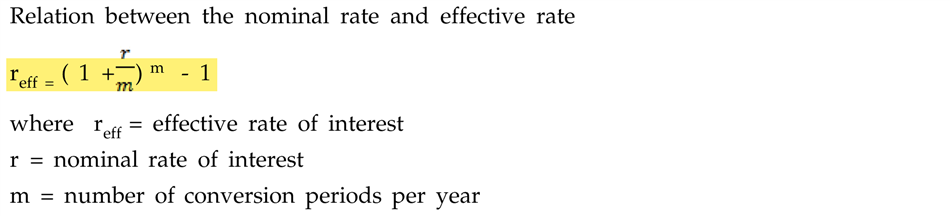
Let \( \mathrm{r_e} \) denote the effective rate corresponding to the nominal rate r, compounded m times in a year. Let P be the principal and rate per conversion period is \( i=\displaystyle\frac{\mathrm{r}}{\mathrm{m}} \), then effective rate of interest is:
Answer & explanation
Correct answer: option 4
The correct answer is Option (4) → \( \mathrm{r_e}=\left(1+\displaystyle\frac{\mathrm{r}}{\mathrm{m}}\right)^{\mathrm{m}}-1 \)
The effective rate is the annual rate that gives the same interest in one year as the nominal rate r compounded m times.
With principal P, the amount after one year is the same in both cases:
\( \displaystyle \mathrm{P}(1+\mathrm{r_e})=\mathrm{P}\left(1+\frac{\mathrm{r}}{\mathrm{m}}\right)^{\mathrm{m}} \)
Dividing by P:
\( \displaystyle \mathrm{r_e}=\left(1+\frac{\mathrm{r}}{\mathrm{m}}\right)^{\mathrm{m}}-1 \)
Why the other options are incorrect
Option (1) \( \mathrm{r_e}=\mathrm{P}\left(1+\displaystyle\frac{\mathrm{r}}{\mathrm{m}}\right)^{\mathrm{m}}-1 \) — Incorrect. P cancels from both sides; a rate cannot depend on the principal.
Option (2) \( \mathrm{r_e}=\left(1+\displaystyle\frac{\mathrm{r}}{\mathrm{m}}\right)^{\mathrm{m}}+1 \) — Incorrect. The 1 must be subtracted, not added; this would make the effective rate greater than 1, that is, more than 100%.
Option (3) \( \mathrm{r_e}=\left(1-\displaystyle\frac{\mathrm{r}}{\mathrm{m}}\right)^{\mathrm{m}}-1 \) — Incorrect. Interest adds to the principal, so the factor is \( 1+\frac{\mathrm{r}}{\mathrm{m}} \); with \( 1-\frac{\mathrm{r}}{\mathrm{m}} \) the effective rate would be negative.
CBSE Applied Mathematics (Class XII):
Nominal and Effective Rate of Interest