Which of the following has the strongest C–X bond?
Answer & explanation
Correct answer: option 4
The correct answer is Option (4) → \(CH_3F\)
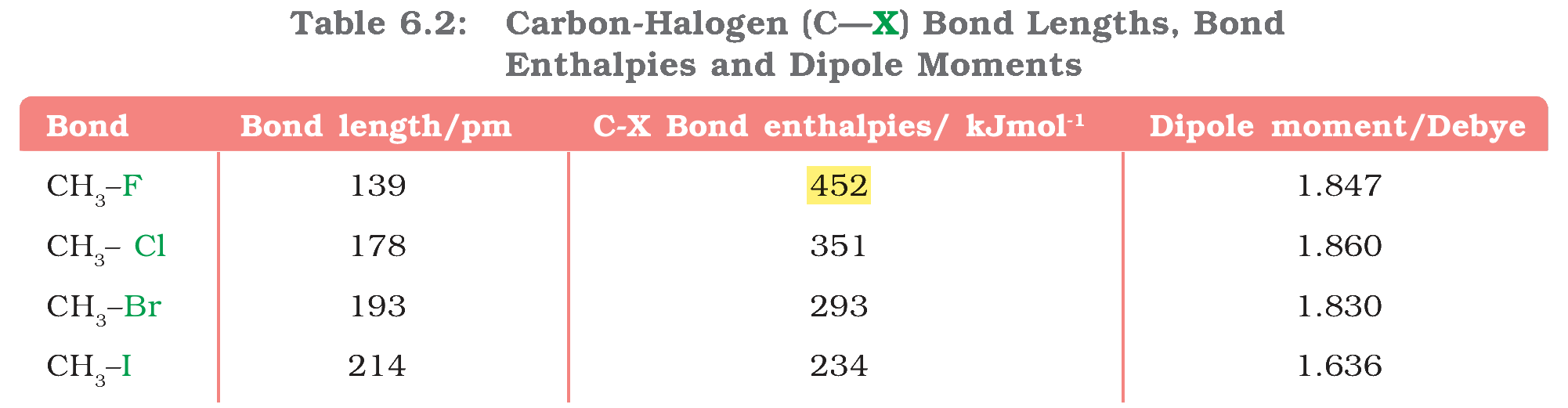
The strength of a bond is measured by its bond enthalpy. Down the halogen group the atom gets larger, so the C–X bond gets longer and weaker. Fluorine is the smallest halogen, so C–F is the shortest and strongest C–X bond:
\( \displaystyle \text{C-F}\ (452) \gt \text{C-Cl}\ (351) \gt \text{C-Br}\ (293) \gt \text{C-I}\ (234)\ \mathrm{kJ\,mol^{-1}} \)
Why the other options are incorrect
Option (1) \(CH_3Br\) — Incorrect. The larger bromine atom gives a longer bond, with bond enthalpy only 293 kJ mol−1.
Option (2) \(CH_3Cl\) — Incorrect. C–Cl (351 kJ mol−1) is weaker than C–F because chlorine is larger than fluorine.
Option (3) \(CH_3I\) — Incorrect. Iodine is the largest halogen, so C–I is the weakest (234 kJ mol−1).
NCERT (2026-27 edition):
6.3 Nature of C-X Bond – “As we go down the group in the periodic table, the size of halogen atom increases. Fluorine atom is the smallest and iodine atom is the largest. Consequently the carbon-halogen bond length also increases from C—F to C—I. Some typical bond lengths, bond enthalpies and dipole moments are given in Table 6.2.”
Table 6.2: Carbon-Halogen (C—X) Bond Lengths, Bond Enthalpies and Dipole Moments