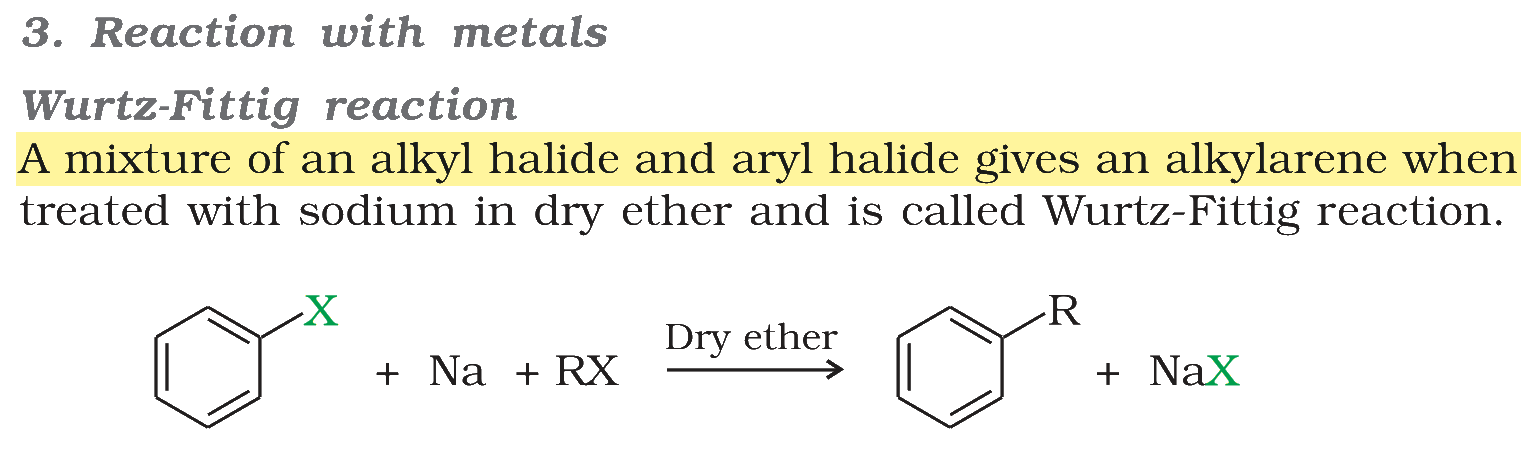
The above reaction is an example of
Answer & explanation
Correct answer: option 3
The correct answer is Option (3) → Wurtz Fittig reaction
Sodium in dry ether joins two organic groups by removing their halogen atoms as sodium halide. The name depends on what is joined:
Wurtz reaction: two alkyl halides give an alkane, \( \ce{2R-X + 2Na} \xrightarrow{\text{dry ether}} \ce{R-R + 2NaX} \).
Fittig reaction: two aryl halides give a diaryl, \( \ce{2Ar-X + 2Na} \xrightarrow{\text{dry ether}} \ce{Ar-Ar + 2NaX} \).
Wurtz-Fittig reaction: an alkyl halide and an aryl halide give an alkylarene, \( \ce{Ar-X + 2Na + R-X} \xrightarrow{\text{dry ether}} \ce{Ar-R + 2NaX} \).
In the given reaction, chlorobenzene (an aryl halide) and chloromethane (an alkyl halide) are joined to give toluene:
\( \displaystyle \ce{C6H5Cl + 2Na + CH3Cl} \xrightarrow[\text{heat}]{\text{dry ether}} \ce{C6H5CH3 + 2NaCl} \)
So this is the Wurtz-Fittig reaction.
Why the other options are incorrect
Option (1) Sandmeyer’s reaction — Incorrect. This replaces the diazonium group of a benzenediazonium salt by Cl, Br or CN using cuprous salts, for example \( \ce{C6H5N2+Cl-} \xrightarrow{\ce{Cu2Cl2/HCl}} \ce{C6H5Cl + N2} \); no sodium or alkyl halide is involved.
Option (2) Wurtz reaction — Incorrect. This joins two alkyl halides; here one of the halides is an aryl halide.
Option (4) Kolbe reaction — Incorrect. In Kolbe’s reaction sodium phenoxide reacts with \( \ce{CO2} \) to give salicylic acid; it has nothing to do with coupling halides.
\( \ce{C6H5ONa} \xrightarrow[\text{(ii) }\ce{H+}]{\text{(i) }\ce{CO2},\ 400\,\text{K},\ 4\text{-}7\,\text{atm}} \ce{o-HOC6H4COOH} \)
NCERT (2026-27 edition):
Reaction with Metals