
Read the passage and answer the following questions:
Mutualism is an interaction that benefits both species involved. One example of mutualism is the lichen, an intimate association between a fungus and photosynthesising algae or cyanobacteria, which rely on each other for survival. The fungus provides a protected environment and absorbs water and nutrients, while the photosynthetic partner conducts photosynthesis and produces energy-rich carbohydrates that benefit both organisms. Another example is mycorrhizae, where fungi form associations with the roots of higher plants. The fungi assist the plants in absorbing essential nutrients from the soil, such as phosphorus, in exchange for receiving energy-yielding carbohydrates produced by the plants through photosynthesis. In plant-animal relationships, mutualism is evident in the process of pollination and seed dispersal. Plants rely on animals, such as bees, butterflies, and birds, to transfer pollen between flowers, facilitating reproduction. In return, plants offer rewards to the pollinators, such as pollen and nectar, which serve as a source of food for the animals. Similarly, when animals consume fruits and disperse seeds through their excretion or by carrying them to new locations, they benefit from the nutritional value of the fruits, while the plants benefit from the dispersal of their seeds. Not all mutualistic interactions involve direct rewards. Some orchids, like the Mediterranean orchid Ophrys, employ "sexual deceit" to achieve pollination. One petal of the flower resembles the female bee in size, colour and markings, attracting male bees that attempt to mate with the flower. During this process, the bee gets covered in pollen, and when it visits another flower, it transfers the pollen, facilitating pollination.
Choose the correct statements about the relationship between fig trees and their pollinator wasps:
A. Many species of fig trees show a tight one-to-one relationship with the pollinator species of wasp.
B. The female wasp uses the fig fruit as an oviposition (egg-laying) site.
C. The developing seeds within the fig fruit nourish the wasp larvae.
D. The wasp pollinates the fig inflorescence while searching for nectar.
Choose the correct answer from the options given below:
Answer & explanation
Correct answer: option 4
The correct answer is Option (4) → A, B and C only
The fig and its pollinator wasp form one of the closest mutualisms in the book. Many fig species have a tight one-to-one relationship with their own wasp species, and each partner gets something it cannot do without.
A. Many species of fig trees show a tight one-to-one relationship with the pollinator species of wasp. — True. A given fig species can be pollinated only by its own ‘partner’ wasp species.
B. The female wasp uses the fig fruit as an oviposition (egg-laying) site. — True. The female wasp lays her eggs inside the fruit.
C. The developing seeds within the fig fruit nourish the wasp larvae. — True. This is the fig’s return for pollination: it gives some of its developing seeds as food for the wasp larvae.
D. The wasp pollinates the fig inflorescence while searching for nectar. — False. The wasp pollinates the fig inflorescence while searching for suitable egg-laying sites. Its reward is a place to lay eggs and seeds for its larvae, not nectar.
So A, B and C are correct and D is not, which is Option (4).
NCERT Extract:
Population Interactions – “… In many species of fig trees, there is a tight one-to-one relationship with the pollinator species of wasp (Figure 11.4). It means that a given fig species can be pollinated only by its ‘partner’ wasp species and no other species. The female wasp uses the fruit not only as an oviposition (egg-laying) site but uses the developing seeds within the fruit for nourishing its larvae. The wasp pollinates the fig inflorescence while searching for suitable egg-laying sites. In return for the favour of pollination the fig offers the wasp some of its developing seeds, as food for the developing wasp larvae.”
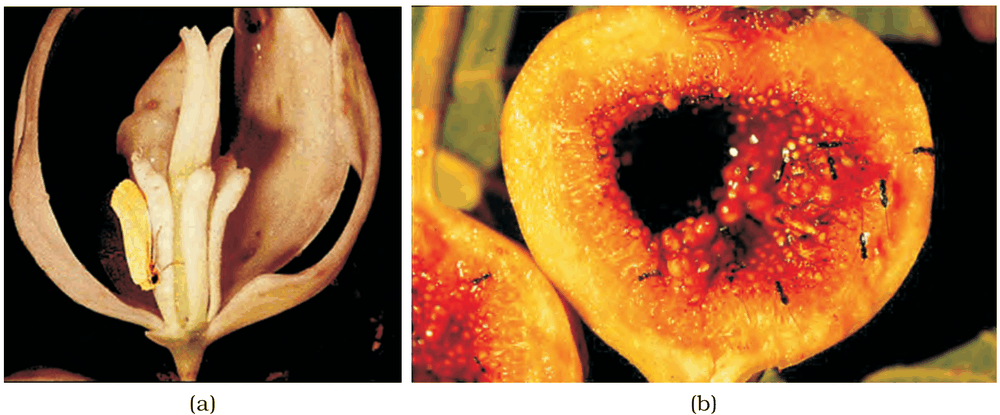
Figure 11.4 Mutual relationship between fig tree and wasp: (a) Fig flower is pollinated by wasp; (b) Wasp laying eggs in a fig fruit