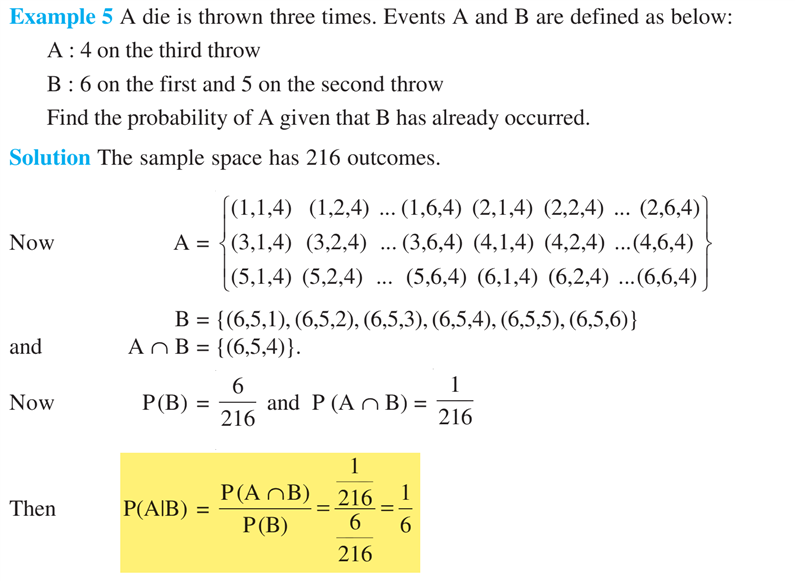
A die is thrown three times. Events A and B are defined as below
A : 6 on the third throw
B : 4 on the first and 5 on the second throw
The probability of A given that B has already occurred, is:
Answer & explanation
Correct answer: option 1
The correct answer is Option (1) → 1/6
By the conditional probability formula \(P(A|B) = \frac{P(A \cap B)}{P(B)}\). The three throws are independent, each face having probability \(\frac{1}{6}\):
\( \displaystyle P(B) = \frac{1}{6}\times\frac{1}{6} = \frac{1}{36} \)
A ∩ B is “4, then 5, then 6”:
\( \displaystyle P(A \cap B) = \frac{1}{6}\times\frac{1}{6}\times\frac{1}{6} = \frac{1}{216} \)
\( \displaystyle P(A|B) = \frac{1/216}{1/36} = \frac{1}{6} \)
This is just P(A): the third throw does not depend on the first two, so A and B are independent events.
NCERT (2026-27 edition):
Conditional Probability