
CUETMOCK
  • Pricing
  • Mentors
Log inStart freeStart free mocks→

First test, then trust

Try a free CUET mock test.

Join 5,00,000+ students who rehearsed exam day on the exact NTA screen before sitting CUET. On the web and on Android.

Start free mocks →Get the Android app
CUETMOCK

India's #1 CUET Mock Test Platform. Original NCERT-based questions on the exact NTA exam screen — trusted by 5,00,000+ students since CUET 2022.

Get it onGoogle PlayScan to download the CUETMOCK app

Mock tests

  • CUET mock test series
  • Commerce mocks
  • Humanities (Arts) mocks
  • Science mocks
  • Languages & GAT mocks
  • Free practice questions
  • Pricing

Resources

  • CUET exam guide
  • CUET syllabus
  • Universities accepting CUET
  • Expert blogs
  • News & notifications
  • Webinars & counselling
  • CUET score calculator
  • How we estimate your rank
  • FAQs

Company

  • About us
  • Our leadership & team
  • Our toppers
  • Mentors
  • For schools
  • Contact us
  • Terms
  • Privacy
  • Refund policy

Talk to us

+91 7696 6630 56info@cuetmock.comWhatsApp us

Our other platforms

  • JEE Mock — For IIT-JEE aspirants
  • NEET Mock — For NEET aspirants

Newsletter

Exam updates, study material and offers — no spam.

© 2026 NYC Ventures Pvt. Ltd.

701-702, Royal Business Park, Zirakpur, Punjab - 140603

  • Terms of use
  • Privacy policy
  • Refund policy
  • Contact us

iCUETMOCK is an independent preparation platform, not affiliated with the National Testing Agency (NTA). Always check exam details on the official NTA website.

  • Home
  • Mock tests
  • CUET guide
  • Pricing
  • Log in
Home/Practice questions/Biology
BiologyBiotechnology and its Applications

Which of the following steps presented the main challenge in the prod…

Which of the following steps presented the main challenge in the production of human insulin using recombinant DNA technology?

Answer & explanation+

Correct answer: option 3

The correct answer is Option (3) → Achieving the correct assembly of insulin into its mature form

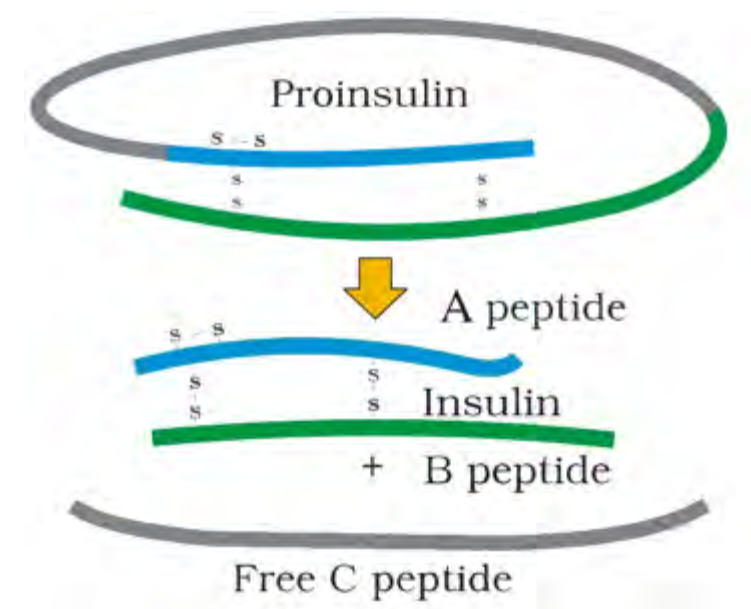
Insulin has two short polypeptide chains, A and B, joined by disulphide bridges. In the body it is first made as pro-insulin, which has an extra stretch called the C peptide. The C peptide is removed during maturation, and only then is the hormone active. Getting this mature, correctly assembled insulin was the main challenge in making it by rDNA techniques. Eli Lilly solved it in 1983 by making chains A and B separately in E. coli and then joining them by disulphide bonds.

Option (1) Separating the A and B peptide chains — Incorrect. In the rDNA method chains A and B were made separately in E. coli and then combined by disulphide bonds. The difficulty lay in joining them into mature insulin, not in separating them.

Option (2) Incorporating the C-peptide into proinsulin — Incorrect. The C peptide is removed during maturation and is not present in mature insulin. Adding it was never the aim.

Option (3) Achieving the correct assembly of insulin into its mature form — Correct. The book says the main challenge was getting insulin assembled into a mature form.

NCERT Extract:
Genetically Engineered Insulin – “… This C peptide is not present in the mature insulin and is removed during maturation into insulin. The main challenge for production of insulin using rDNA techniques was getting insulin assembled into a mature form. In 1983, Eli Lilly an American company prepared two DNA sequences corresponding to A and B, chains of human insulin and introduced them in plasmids of E. coli to produce insulin chains. Chains A and B were produced separately, extracted and combined by creating disulfide bonds to form human insulin.”
Textbook figure

Figure 10.3 Maturation of pro-insulin into insulin (simplified)

Advertisement

Practise more on Biotechnology and its Applications

Chapter-wise mocks on the real NTA exam screen, with solutions and your rank. Your first mocks are free.

Start free mocks →

Advertisement

Next questions

  1. The shortest distance between the lines (x-2)/3=(y+1)/2=(z-4)/(-1) and (x-2)/1=(y+1)/(-4)=(z-4)/5 isMaths. Section B1 · Three-dimensional Geometry
  2. 20 g of a substance were dissolved in 500 mL of water and the osmotic pressure of the solution was found to be 600 mm of mercury at 15°C. T…Chemistry · Physical: Solutions
  3. Chemistry · Organic: Aldehydes, Ketones and Carboxylic Acids
  4. Who among the following has written the book ‘A century is not enough: my roller coaster ride to success’?General Aptitude Test · General Knowledge
  5. Fill in the blanks in the sentences given in List-I with the appropriate adjectives given in List-II:List-I (Sentences)List-II (Adjectives)…English · Grammar: Adjective
  6. Which of the following is compound E?Chemistry · Inorganic: D and F Block Elements
  7. From the given option choose the one which in the correct exclamatory form of the sentence-It is a great pity that you have lost the final…English · Kinds of Sentence
  8. Identify from the options given below, the signatures used by the Vijayanagara kings on all royal orders.History · Medieval India: An Imperial Capital: Vijayanagara
  9. Read the given statements and conclusions carefully. Assuming that the information given in the statements is true, even if it appears to b…General Aptitude Test · Verbal Reasoning
  10. Which of the following is an example of esteem needs?Business Studies · Directing