
In the context of the given picture, answer the following questions:
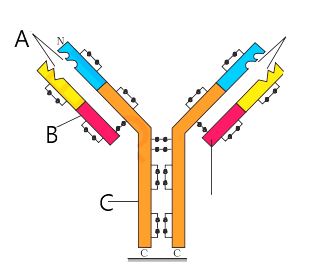
Which among the following cells produce antibodies in response to pathogens in our blood to fight them?
Answer & explanation
Correct answer: option 2
The correct answer is Option (2) → B-lymphocytes
Acquired immunity is carried out by two special kinds of lymphocytes in our blood: B-lymphocytes and T-lymphocytes. Antibodies are proteins that bind to pathogens and help destroy them. The Y-shaped molecule in the picture is one such antibody.
Option (1) T-lymphocytes — Incorrect. T-lymphocytes (T-cells) do not secrete antibodies themselves. They help B-cells to produce antibodies, and they also carry out cell-mediated immunity, for example in graft rejection.
Option (2) B-lymphocytes — Correct. B-lymphocytes produce a large number of proteins, an “army of proteins”, when a pathogen enters the blood. These proteins are the antibodies. Because they act in the blood, this response is called the humoral immune response.
Option (3) Both T-lymphocytes and B-lymphocytes — Incorrect. Only B-lymphocytes make antibodies. T-lymphocytes help them but do not secrete antibodies, so “both” is wrong.
NCERT Extract:
Acquired Immunity – “… The primary and secondary immune responses are carried out with the help of two special types of lymphocytes present in our blood, i.e., B-lymphocytes and T-lymphocytes. The B-lymphocytes produce an army of proteins in response to pathogens into our blood to fight with them. These proteins are called antibodies. The T-cells themselves do not secrete antibodies but help B cells to produce them.”