
Match List – I with List – II.
|
List - I |
List - II |
|
(A) $x^x$ has a stationary point at x equal to |
(I) $e$ |
|
(B) For x > 0, minimum value of $x^x$ |
(II) $\frac{1}{e}$ |
|
(C) The greatest value of $\left(\frac{1}{x}\right)^x$ |
(III) $e^{\frac{1}{e}}$ |
|
(D) The stationary point of $\frac{\log x}{x}$ for x, where x > 0, is |
(IV) $e^{\frac{-1}{e}}$ |
Choose the correct answer from the options given below:
Answer & explanation
Correct answer: option 2
The correct answer is Option (2) → (A)-(II), (B)-(IV), (C)-(III), (D)-(I)
(A) $y=x^x$
$y'=x^x(1+\log x)=0$
$x=\frac{1}{e}$ stationary point (II)
(B) $y=x^x$
as $y'=x^x(1+\log x)=0$
$⇒x=\frac{1}{e}$
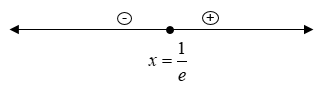
So $\frac{1}{e}$ point of minima
$y_{min}=(\frac{1}{e})^{\frac{1}{e}}=e^{\frac{-1}{e}}$ (IV)
(C) $y=(\frac{1}{x})^x$ so $y=x^{-x}$
$y'=-x^{-x}(1+\log x)=0$
$⇒x=\frac{1}{e}$
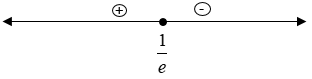
so $\frac{1}{e}$ point of maxima
$y_{max}=y(\frac{1}{e})=e^{\frac{1}{e}}$ (III)
(D) $y=\frac{\log x}{x}⇒y'=\frac{1}{x^2}-\frac{\log x}{x^2}=0$
$⇒x=e$ stationary point (I)