The widespread aspect of Globalisation of agriculture is the entry of multinationals into this sector as sellers of agricultural inputs such as seeds, pesticides and fertilisers. Over the last decade or so, the Govt. has scaled down its agricultural development programmes, and agricultural extension agents have been replaced in the villages by agents of seeds, fertilisers, and pesticides companies. These agents are often the sole source of information for farmers about new seeds or cultivation practices with of course interest in selling their product. This increased dependence of farmers on expensive fertilisers and pesticides, which has reduced their profits and put many farmers into debt and created ecological crisis in rural areas.
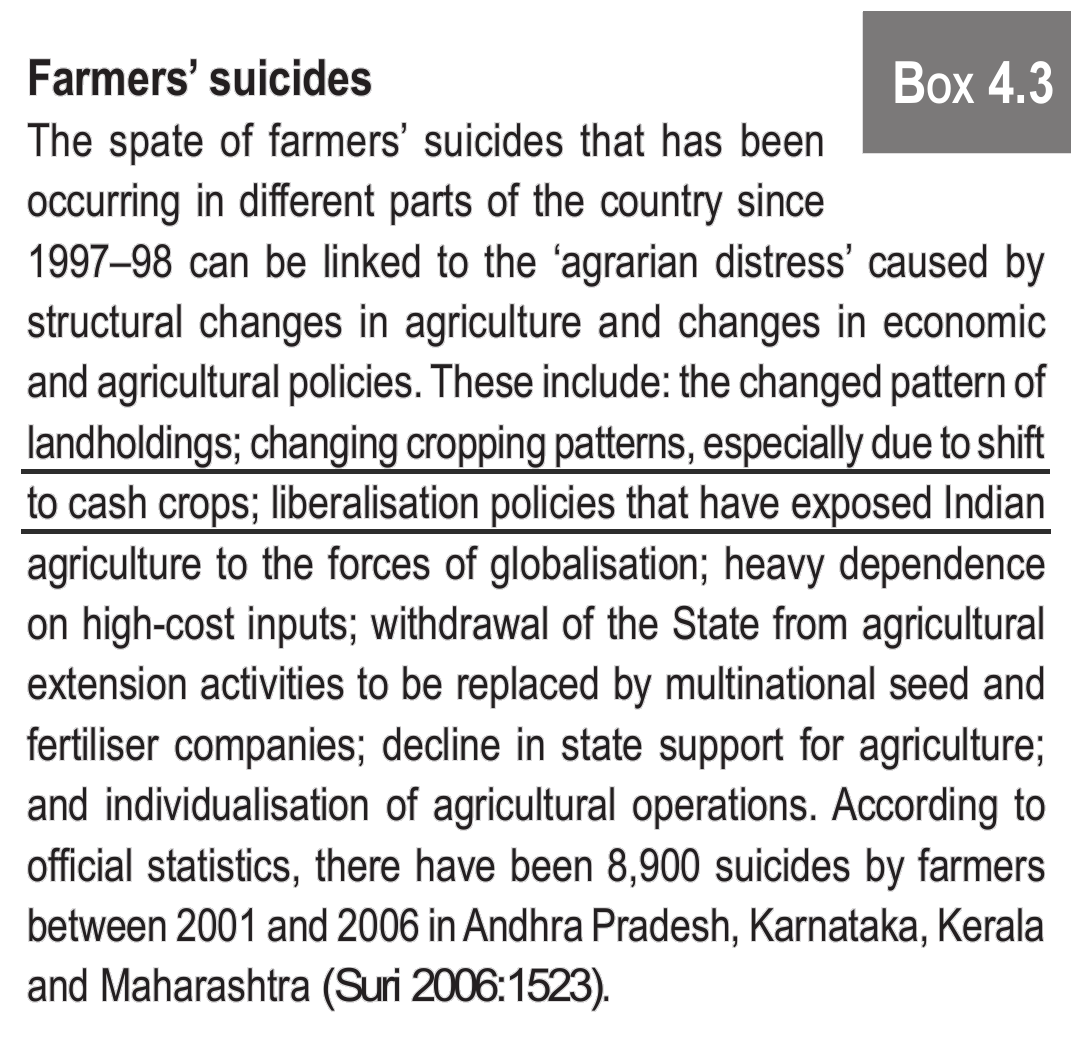
Due to these economic and ecological crisis the spate of farmer's suicide have been occurring in different parts of the country since 1997-98. These suicides can be linked to changes in economic and agricultural policies. These include : the changed pattern of landholdings, changing crop patterns, shift to cash crops, liberalization policies that have exposed Indian agriculture to the forces of Globalisation; heavy dependence on high-costs inputs and individualisation of agricultural operations. According to official statistics, there have been 8,900 suicides by farmers between 2001 and 2006 in Andhra Pradesh, Karnataka, Kerala, Maharashtra.
How can farmers' suicides be reduced ?
(1) Increasing the agricultural subsidies
(2) Liberalization policies
(3) Shifting to cash crops
(4) Unstable markets
Answer & explanation
Correct answer: option 1
The correct answer is Option (1) → Increasing the agricultural subsidies
Option (1) Increasing the agricultural subsidies — Correct. Many farmers who took their lives were marginal farmers trying to raise their productivity, and the cost of production has increased tremendously due to a decrease in agricultural subsidies. A subsidy is help from the government that lowers the price the farmer pays for inputs such as seed, fertiliser and power. Raising subsidies lowers the cost of cultivation, so the farmer borrows less and is less likely to fall into the debt that lies behind these suicides.
Option (2) Liberalization policies — Incorrect. Liberalisation policies are among the causes linked to the suicides: they have exposed Indian agriculture to the forces of globalisation, so the farmer faces falling prices and costly inputs from big companies.
Option (3) Shifting to cash crops — Incorrect. The shift to cash crops is itself one of the changes the suicides are linked to. A farmer who grows a single crop for the market can be ruined by a fall in prices or a bad crop.
Option (4) Unstable markets — Incorrect. Unstable markets are a risk that pushes farmers into distress: when prices fall, the farmer cannot repay what he borrowed. They add to the problem rather than reduce it.
Note: NCERT gives the causes of farmers’ suicides, among them the rise in the cost of production after the cut in agricultural subsidies, but does not say how the suicides can be reduced. The answer follows by reasoning: raising the subsidies removes one of these causes, while the other three options are themselves among the causes.
NCERT (2025-26): “Many farmers, who have committed suicide were marginal farmers, who were attempting to increase their productivity, primarily by practising Green Revolution methods. However, undertaking such production meant facing several risks: the cost of production has increased tremendously due to a decrease in agricultural subsidies, the markets are not stable, and many farmers borrow heavily in order to invest in expensive inputs and improve their production.…”
Box 4.3, Farmers’ suicides |