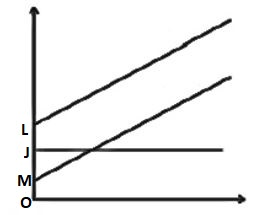
From the following figure, how to obtain an aggregate demand function?
Answer & explanation
Correct answer: option 4
The correct answer is Option (4) → OL
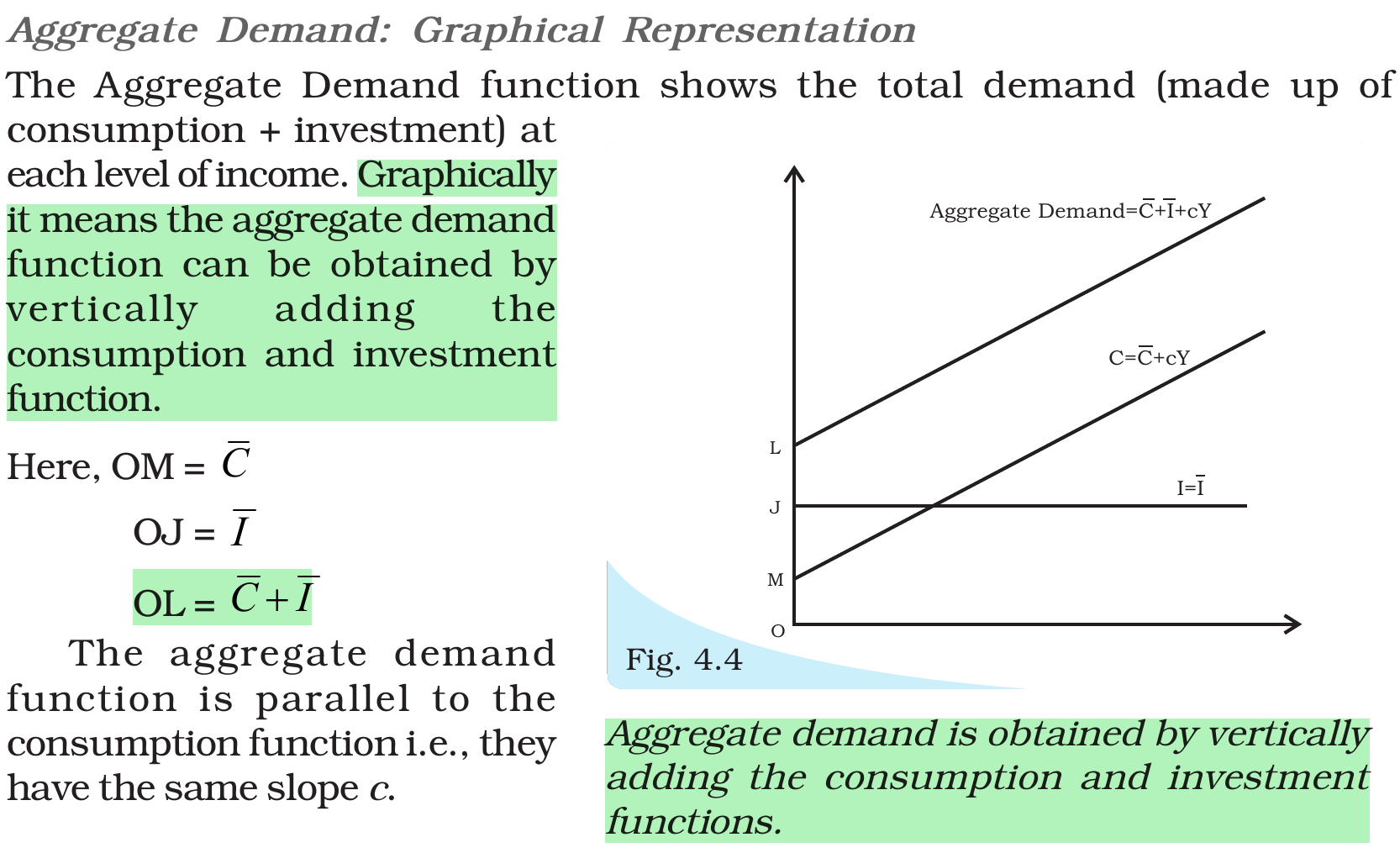
The aggregate demand function is obtained by vertically adding the consumption function and the investment function. In the figure, the consumption line starts at M and the investment line runs flat from J. So at zero income, OM is autonomous consumption \( \bar C \) and OJ is investment \( \bar I \). The aggregate demand line starts at L, where OL = \( \bar C + \bar I \).
Option (1) OM — Incorrect. OM is only autonomous consumption. It leaves out investment.
Option (2) JM — Incorrect. JM is the gap between the investment and consumption lines at zero income. Aggregate demand comes from adding the two, and this gap does not add them.
Option (3) LM — Incorrect. LM is the vertical distance between the two parallel lines. It equals OJ, so it is investment alone.
Option (4) OL — Correct. OL is OM + OJ, the height of the aggregate demand line at zero income.
Note: It seems that there is a mistake in the original NTA question. It asks how to obtain a function, but its options are line segments. The answer comes from the height of the aggregate demand line at zero income.
NCERT (2026-27): Introductory Macroeconomics — Chapter 4: Determination of Income and Employment
|