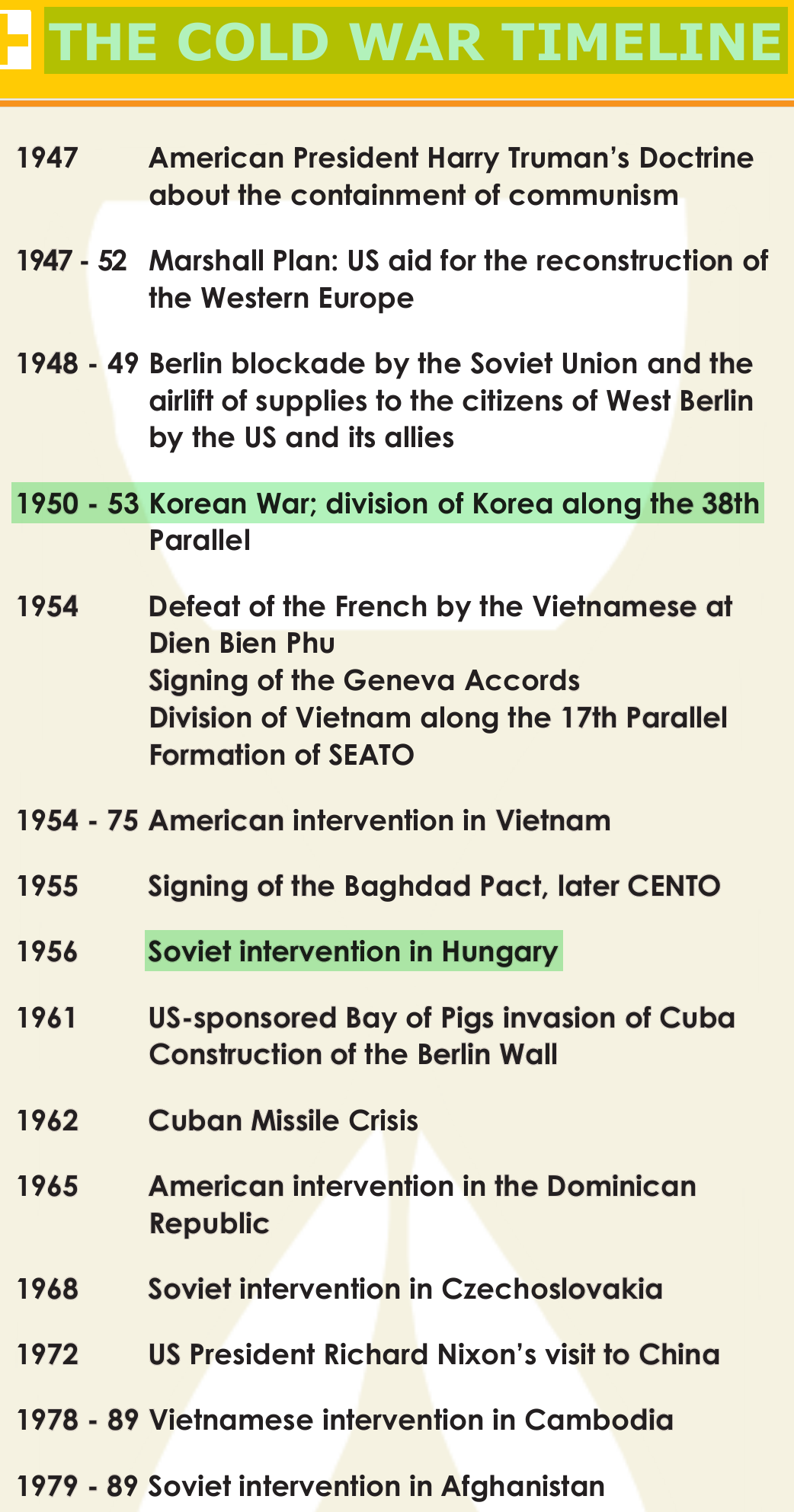
Match List-I with List-II.
| List-I | List-II | ||
| (A) | Soviet intervention in Hungary | (I) | 1955 |
| (B) | NATO | (II) | 1950-53 |
| (C) | Warsaw Pact | (III) | 1956 |
| (D) | Korean Conflict | (IV) | 1949 |
Choose the correct answer from the options given below:
Answer & explanation
Correct answer: option 1
The correct answer is Option (1) → (A)-(III), (B)-(IV), (C)-(I), (D)-(II)
(A) Soviet intervention in Hungary — this matches (III) 1956.
(B) NATO — this matches (IV) 1949.
(C) Warsaw Pact — this matches (I) 1955.
(D) Korean Conflict — this matches (II) 1950-53.
Note: This question is taken from the chapter ‘The Cold War Era’ which was there in the pre-rationalised NCERT and has been deleted from subsequent editions of NCERT, including the NCERT book (2026-27).
NCERT (Pre-rationalised): Contemporary World Politics — Chapter 1: The Cold War Era
NCERT (Pre-rationalised): “THE EMERGENCE OF TWO POWER BLOCS … The western alliance was formalised into an organisation, the North Atlantic Treaty Organisation (NATO), which came into existence in April 1949. It was an association of twelve states which declared that armed attack on any one of them in Europe or North America would be regarded as an attack on all of them. Each of these states would be obliged to help the other. The eastern alliance, known as the Warsaw Pact, was led by the Soviet Union. It was created in 1955 and its principal function was to counter NATO’s forces in Europe.…” |