Match List I with List II
| List I | List II |
| A. Invert sugar | I. \(\alpha \)-D-glucose and \(\alpha \)-D-glucose |
| B. Maltose | II. \(\beta \)-D-galactose and \(\beta \)-D-glucose |
| C. Lactose | III. branched chain polymer of \(\alpha \)-D-glucose |
| D. Amylopectin | IV. Hydrolysis of sucrose |
Choose the correct answer from the options given below:
Answer & explanation
Correct answer: option 3
The correct answer is option 3. A-IV, B-I, C-II, D-III.
| List I | List II |
| A. Invert sugar | IV. Hydrolysis of sucrose |
| B. Maltose | I. \(\alpha \)-D-glucose and \(\alpha \)-D-glucose |
| C. Lactose | II. \(\beta \)-D-galactose and \(\beta \)-D-glucose |
| D. Amylopectin | III. branched chain polymer of \(\alpha \)-D-glucose |
A. Invert sugar: IV. Hydrolysis of sucrose:
Sucrose is called "invert sugar" because of a specific property related to its hydrolysis process. When sucrose undergoes hydrolysis, the resulting mixture contains equal parts of glucose and fructose. This mixture is called "invert sugar."
The term "invert" refers to the change in the optical rotation of polarized light that occurs during the hydrolysis of sucrose. Sucrose itself has a specific optical rotation. However, when it is hydrolyzed into glucose and fructose, the resulting mixture has a different optical rotation. This change in optical rotation is referred to as "inversion."
Specifically, sucrose is dextrorotatory (it rotates polarized light to the right). However, the mixture of glucose and fructose obtained from the hydrolysis of sucrose is levorotatory (it rotates polarized light to the left). This inversion of the optical rotation is why the resulting mixture is called "invert sugar."
So, the term "invert sugar" not only refers to the process of hydrolyzing sucrose but also to the change in optical properties that occurs during this process.
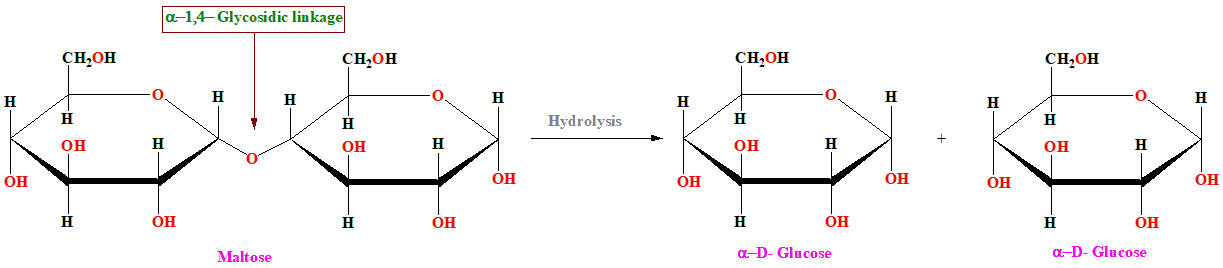
B. Maltose: I. \(\alpha \)-D-glucose and \(\alpha \)-D-glucose:
Maltose is a disaccharide composed of two glucose molecules linked together by an α(1→4) glycosidic bond. This linkage occurs between the first carbon atom (anomeric carbon) of one glucose molecule and the fourth carbon atom of the other glucose molecule.
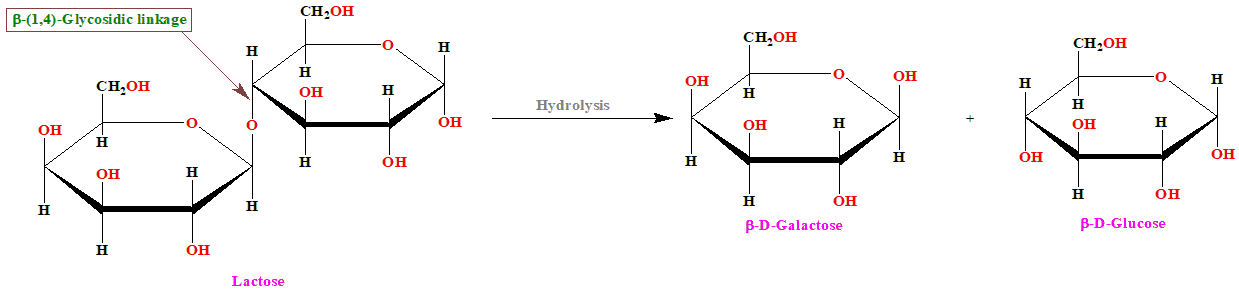
 C. Lactose: II. \(\beta \)-D-galactose and \(\beta \)-D-glucose:
Lactose is a disaccharide composed of one molecule of β-D-galactose and one molecule of β-D-glucose linked together by a β(1→4) glycosidic bond. This linkage occurs between the first carbon atom (anomeric carbon) of the glucose molecule and the fourth carbon atom of the galactose molecule.
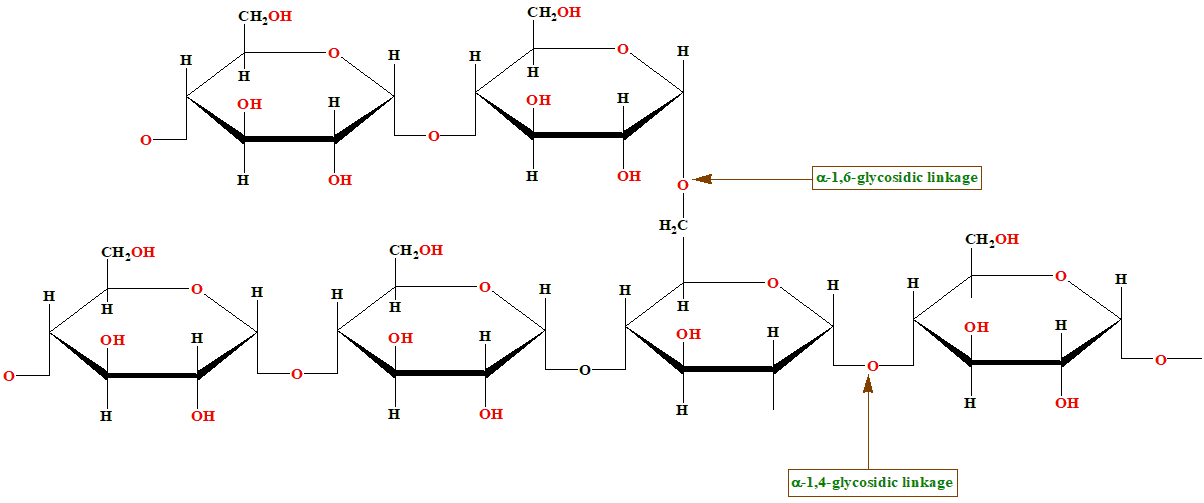
 D. Amylopectin: III. branched chain polymer of \(\alpha \)-D-glucose:
Amylopectin is a branched chain polymer of \(\alpha \)-D-glucose units. Amylopectin is one of the two components of starch, alongside amylose. It is a polysaccharide made up of \(\alpha \)-D-glucose units joined together by glycosidic bonds. Unlike amylose, which forms a linear chain, amylopectin is highly branched. It consists of a main chain of \(\alpha \)-D-glucose units connected by \(\alpha \)(1→4) glycosidic bonds, with branches formed by \(\alpha \)(1→6) glycosidic bonds at regular intervals along the main chain.