Read the passage given below to answer the following questions:
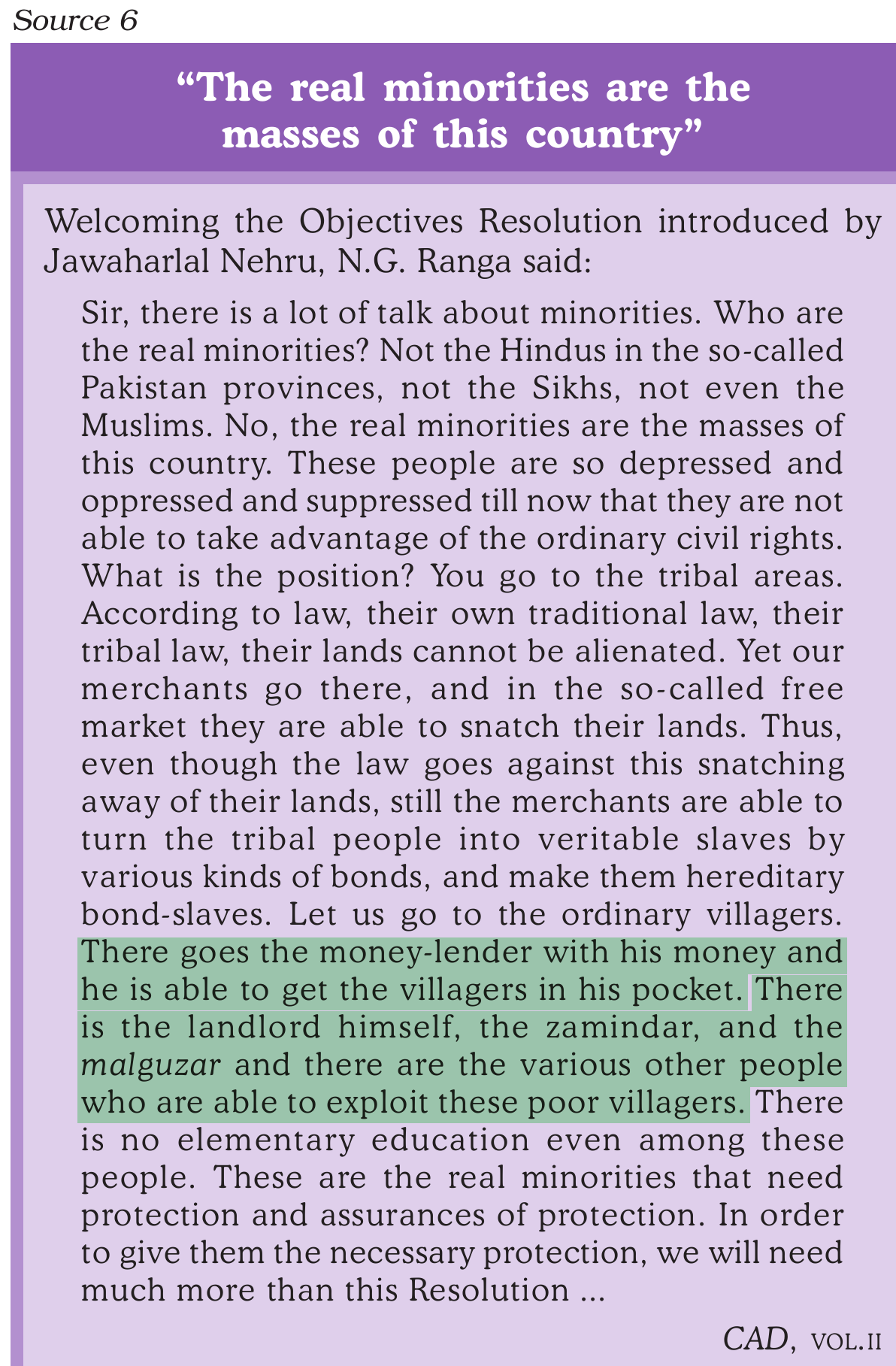
Welcoming the Objectives Resolution introduced by Jawaharlal Nehru, N.G. Ranga said:
Sir, there is a lot of talk about minorities. Who are the real minorities? Not the Hindus in the so-called Pakistan provinces, not the Sikhs, not even the Muslims. No, the real minorities are the masses of this country. These people are so depressed and oppressed and suppressed till now that they are not able to take advantage of the ordinary civil rights. What is the position? You go to the tribal areas. According to law, their own traditional law, their tribal law, their lands cannot be alienated. Yet our merchants go there, and in the so called free market they are able to snatch their lands. Thus, even though the law goes against this snatching away of their lands, still the merchants are able to turn the tribal people into veritable slaves by various kinds of bonds, and make them hereditary bond-slaves. Let us go to the ordinary villagers. There goes the money-lender with his money and he is able to get the villagers in his pocket. There is the landlord himself, the zamindar, and the malguzar and there are the various other people who are able to exploit these poor villagers. There is no elementary education even among these people. These are the real minorities that need protection and assurances of protection. In order to give them the necessary protection, we will need much more than this Resolution.
Many people in the villages exploit the tribal and village people. Who among the following is not one of them?
Answer & explanation
Correct answer: option 4
The correct answer is Option (4) → Under-Ryot
In the villages, Ranga names the money-lender, the landlord (the zamindar) and the malguzar as the people who exploit the poor villagers; the under-ryot is not one of them.
Note: The passage of this question is Source 6, N.G. Ranga’s speech welcoming the Objectives Resolution, in the NCERT chapter ‘Framing the Constitution’. The sources printed in a chapter come back as passages, so read each one along with the lines of the chapter around it.
NCERT: Themes in Indian History Part III — Chapter 12: Framing the Constitution (2026-27)
|