
PQR is a right-angled prism with the other angles \( 60^\circ \) and \( 30^\circ \). The refractive index of the prism is 1.5. The face PQ has a thin layer of liquid on it. Light falls normally on the face PR. For total internal reflection at PQ, the maximum refractive index of the liquid is
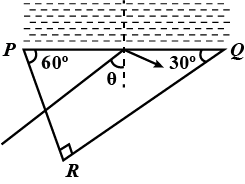
Answer & explanation
Correct answer: option 2
The correct answer is Option (2) → 1.3
Light that meets a face along the normal passes through it undeviated. At the face PQ, total internal reflection back into the glass needs the angle of incidence to be at least the critical angle \( i_c \). Here \( \sin i_c=n_l/n_g \) for light going from glass (\( n_g=1.5 \)) towards the liquid (\( n_l \)).
From the figure, the angle at R is \( 90^\circ \), so the face RQ is perpendicular to PR. A ray entering normally through PR travels parallel to RQ. It meets PQ at \( 30^\circ \) to the surface, which is the angle of the prism at Q. The angle of incidence at PQ is:
\( \begin{aligned} \theta &= 90^\circ-30^\circ \\ &= 60^\circ \end{aligned} \)
For total internal reflection, \( \theta\ge i_c \), that is:
\( \displaystyle \sin60^\circ\ge\frac{n_l}{n_g} \)
\( \begin{aligned} n_l &\le n_g\sin60^\circ \\ &= 1.5\times0.866 \\ &\approx 1.3 \end{aligned} \)
Therefore, the refractive index of the liquid can be at most about 1.3.