
Which of the following statements about the transition elements is incorrect?
Answer & explanation
Correct answer: option 4
The correct answer is Option (4) → Down each group of transition elements, the atomic radius increases regularly from the 3d element to the 4d element and again to the 5d element.
Down a group the atomic radius increases from the 3d to the 4d element, but the 5d element is almost the same size as the 4d element above it. The 4f orbitals are filled before the 5d series begins, and the resulting lanthanoid contraction cancels the expected increase in size.
Option (1) The melting points of the third-series transition elements are generally higher than those of the second-series elements, which in turn are generally higher than those of the first-series elements. — Correct about the transition elements. When the melting points of the three series are plotted against atomic number, the 5d curve lies above the 4d curve, which lies above the 3d curve, over most of each series.
Option (2) The metals of the second and third series have greater enthalpies of atomisation than the corresponding elements of the first series. — Correct about the transition elements. This is the trend of the enthalpies of atomisation; it accounts for the much more frequent metal–metal bonding in compounds of the heavy transition metals.
Option (3) The atomic radii of the third-series transition elements after hafnium are almost the same as those of the second-series elements right above them. — Correct about the transition elements. Because of the lanthanoid contraction the 4d and 5d members of a group have similar radii, for example Zr 160 pm and Hf 159 pm.
Option (4) Down each group of transition elements, the atomic radius increases regularly from the 3d element to the 4d element and again to the 5d element. — Incorrect about the transition elements. The radius increases only from 3d to 4d; from 4d to 5d there is virtually no increase.
NCERT (2026-27 edition):
4.3.2 Variation in Atomic and Ionic Sizes of Transition Metals – “… An interesting point emerges when atomic sizes of one series are compared with those of the corresponding elements in the other series. The curves in Fig. 4.3 show an increase from the first (3d) to the second (4d) series of the elements but the radii of the third (5d) series are virtually the same as those of the corresponding members of the second series. This phenomenon is associated with the intervention of the 4f orbitals which must be filled before the 5d series of elements begin.”
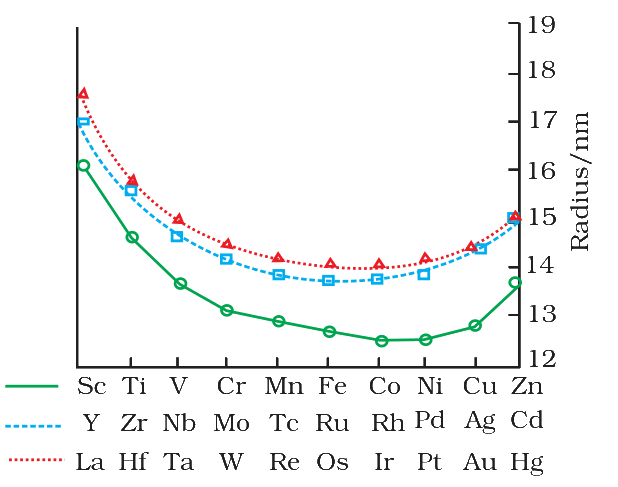
Fig. 4.3: Trends in atomic radii of transition elements