In \(Cu - Ag\) electrochemical cell \(Cu\) acts as
Answer & explanation
Correct answer: option 1
The correct answer is Option (1) → Anode
In a galvanic cell the electrode with the lower (less positive) standard reduction potential is oxidised and acts as the anode; the one with the higher potential is reduced at the cathode.
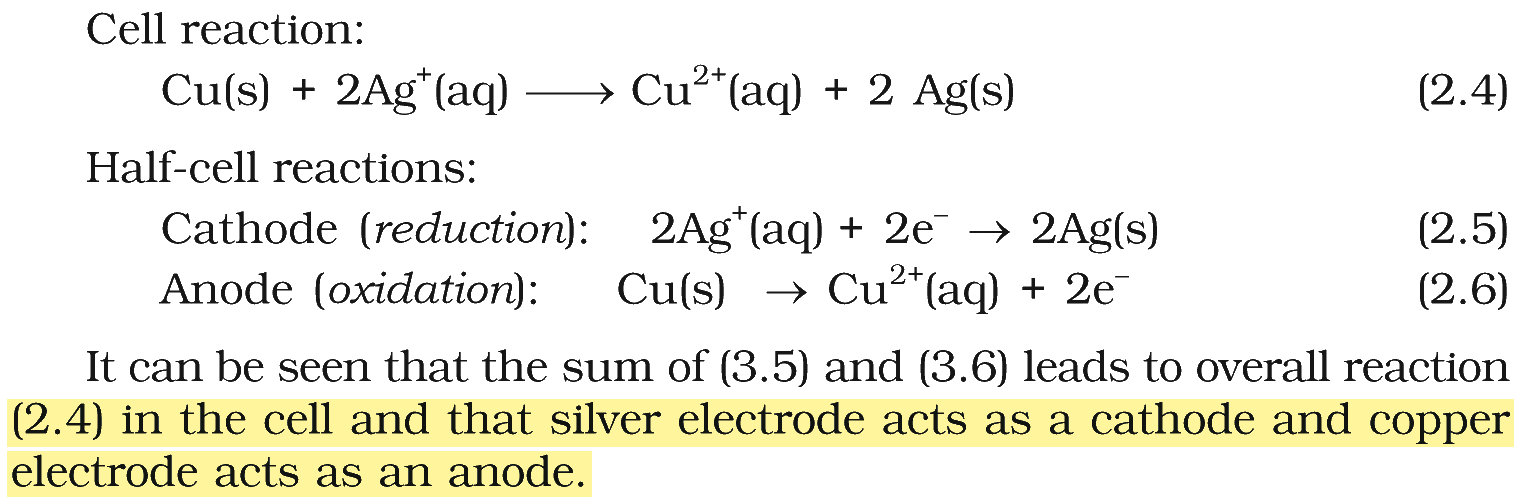
E°(\( \ce{Cu^{2+}} \)/Cu) = +0.34 V and E°(\( \ce{Ag^{+}} \)/Ag) = +0.80 V, so copper is oxidised and silver ions are reduced:
Anode: \( \ce{Cu(s) -> Cu^2+(aq) + 2e-} \)
Cathode: \( \ce{2Ag+(aq) + 2e- -> 2Ag(s)} \)
Cell: \( \ce{Cu(s) + 2Ag+(aq) -> Cu^2+(aq) + 2Ag(s)} \), E°cell = 0.80 − 0.34 = 0.46 V
So in the Cu–Ag cell, Cu(s)|Cu2+(aq)||Ag+(aq)|Ag(s), copper is the anode.
Why the other options are incorrect
Option (2) Cathode — Incorrect. The cathode is the silver electrode, where \( \ce{Ag^{+}} \) ions are reduced.
Option (3) Salt bridge — Incorrect. The salt bridge is a tube of an inert electrolyte such as KCl or \( \ce{KNO3} \) in agar that joins the two solutions; a metal electrode is never the salt bridge.
Option (4) Electrolyte — Incorrect. The electrolytes are the solutions of \( \ce{Cu^{2+}} \) and \( \ce{Ag^{+}} \) salts in which the electrodes dip; copper metal is an electrode, not an electrolyte.
NCERT (2026-27 edition):
Galvanic Cells – …