
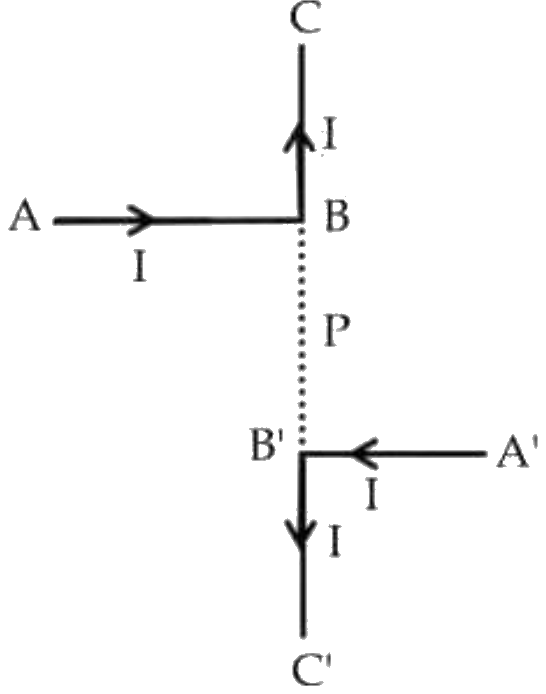
Current through ABC and A'B'C' is I as shown in the given figure. If, PB = PB' = r and C'B'PBC are collinear, the magnetic field at P is :
Answer & explanation
Correct answer: option 2
The correct answer is Option (2) → \( 2\mu_0 I/4\pi r \)
Use the Biot-Savart law for each straight part of the two wires.
The parts BC and B'C' lie on the line through P. For every element of these parts \( d\vec{l} \) is parallel to the line joining it to P, so \( d\vec{l}\times\hat{r} = 0 \) and they give no field at P.
AB ends at B, and P lies on the perpendicular to AB through B, at distance \( r \). The field of such a long straight wire ending at the foot of the perpendicular is half that of an infinite wire.
\( \displaystyle B_{AB} = \frac{1}{2}\cdot\frac{\mu_0 I}{2\pi r} = \frac{\mu_0 I}{4\pi r} \)
In the same way A'B' ends at B' with P on the perpendicular through B' at distance \( r \):
\( \displaystyle B_{A'B'} = \frac{\mu_0 I}{4\pi r} \)
Directions (right-hand rule): AB carries current to the right with P below it, and A'B' carries current to the left with P above it. Both fields at P point into the plane of the paper, so they add.
\( \displaystyle B_P = \frac{\mu_0 I}{4\pi r} + \frac{\mu_0 I}{4\pi r} = \frac{2\mu_0 I}{4\pi r} \)