
Answer & explanation
Correct answer: option 2
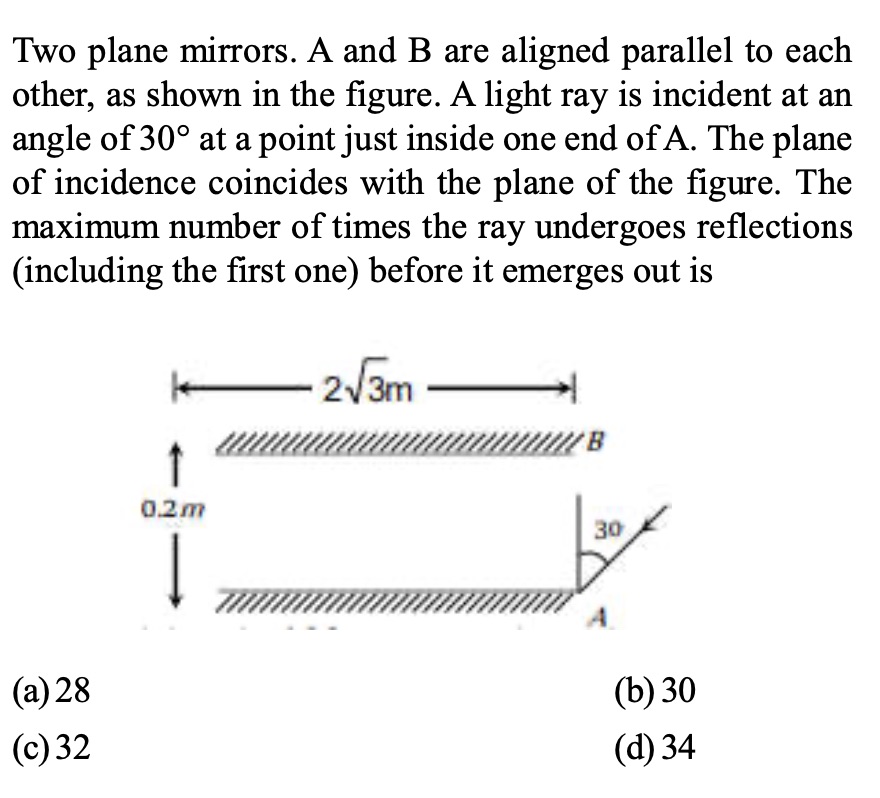
Let the distance covered by the ray after reflection from a surface be d.
From the first law of reflection and alternate angle property, all the angles shown in the figure are equal to $30^o$.
From the figure,
$tan 30^o = \frac{d}{0.2}\times \frac{1}{\sqrt 3}$
$ d = \frac{2}{10\sqrt 3} m $
The ray will not undergo reflection after it emerges out of the arrangement, i.e., after the ray covers $2\sqrt 3$ m.
Therefore the maximum number of reflections that occur =$\frac{2\sqrt 3}{2}{10\sqrt 3} = 30$