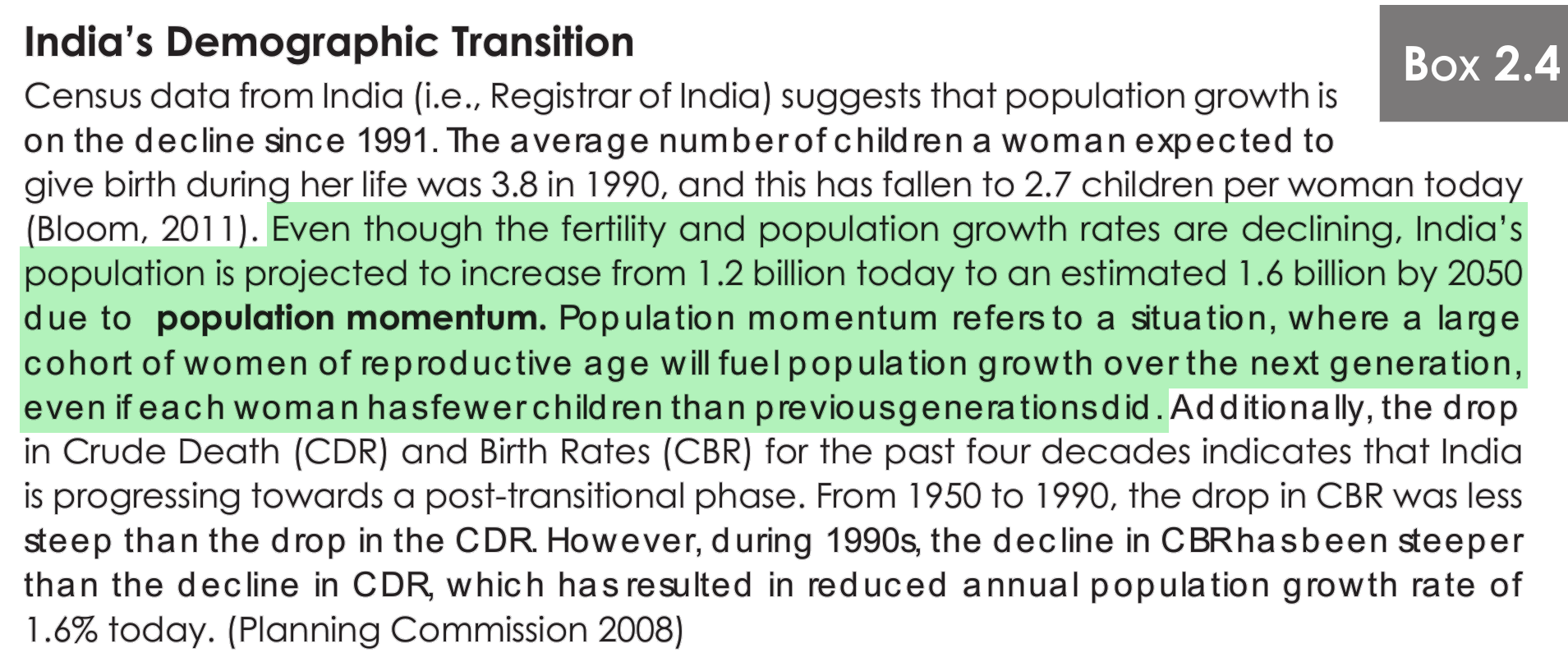
What do you understand by the concept of 'population momentum'?
Answer & explanation
Correct answer: option 4
The correct answer is Option (4) → Refers to a situation, where a large cohort of women of reproductive age will fuel population growth over the next generation, even if each woman has fewer children than previous generations did.
Option (1) Refers to the estimated number of years that an average person is expected to survive. — Incorrect. This is life expectancy. As life expectancy rises, more people live into old age and the age structure of the population changes, but it is not population momentum.
Option (2) Refers to the proportion of persons in different age groups relative to the total population. — Incorrect. This is the age structure of the population, which changes with levels of development and life expectancy.
Option (3) Is a measure comparing the portion of a population which is composed of dependents with the portion that is in the working age group, generally defined as 15 to 64 years. — Incorrect. This is the dependency ratio: the population below 15 or above 64 divided by the population aged 15-64.
Option (4) Refers to a situation, where a large cohort of women of reproductive age will fuel population growth over the next generation, even if each woman has fewer children than previous generations did. — Correct. This is population momentum. When many women are of child-bearing age, the total number of births stays large even though each woman has fewer children. For this reason India’s population is projected to grow from 1.2 billion to about 1.6 billion by 2050, although fertility and population growth rates are falling.
NCERT: Indian Society — Chapter 2: The Demographic Structure of the Indian Society (2025-26)
|