
Consider the following sequence of reactions.
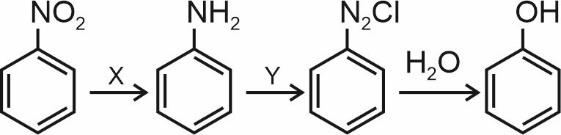
The correct reagent ‘X’ and ‘Y’ are:
Answer & explanation
Correct answer: option 1
The correct answer is Option (1) → X = Sn + HCl, Y = NaNO2 + HCl
Nitrobenzene → aniline (X): nitro compounds are reduced to amines by a metal in acid; Sn + HCl (or Fe + HCl) reduces –\( \ce{NO2} \) to –\( \ce{NH2} \).
\( \ce{C6H5NO2 + 6[H]} \xrightarrow{\ce{Sn/HCl}} \ce{C6H5NH2 + 2H2O} \)
Aniline → benzenediazonium chloride (Y): diazotisation with nitrous acid made in the mixture from NaNO2 + HCl at 273–278 K:
\( \ce{C6H5NH2 + NaNO2 + 2HCl -> C6H5N2+Cl- + NaCl + 2H2O} \)Diazonium salt → phenol: on warming with water the diazonium group is replaced by –OH:
\( \ce{C6H5N2+Cl- + H2O -> C6H5OH + N2 + HCl} \)
Why the other options are incorrect
Option (2) — Incorrect. \( \ce{NaNH2} \) + HCl does not produce nitrous acid, so it cannot diazotise aniline.
Option (3) — Incorrect. Fe + HCl can reduce nitrobenzene, but \( \ce{NaNH2} \) + HCl again cannot carry out diazotisation.
Option (4) — Incorrect. \( \ce{NaNO3} \) is a nitrate; diazotisation needs a nitrite (\( \ce{NaNO2} \)) to give nitrous acid.
NCERT (2026-27 edition):
Chemical Reactions – “… (b) Aromatic amines react with nitrous acid at low temperatures (273-278 K) to form diazonium salts, a very important class of compounds used for synthesis of a variety of aromatic compounds discussed in Section 9.7.”
Replacement by Hydroxyl Group – “If the temperature of the diazonium salt solution is allowed to rise upto 283 K, the salt gets hydrolysed to phenol.”