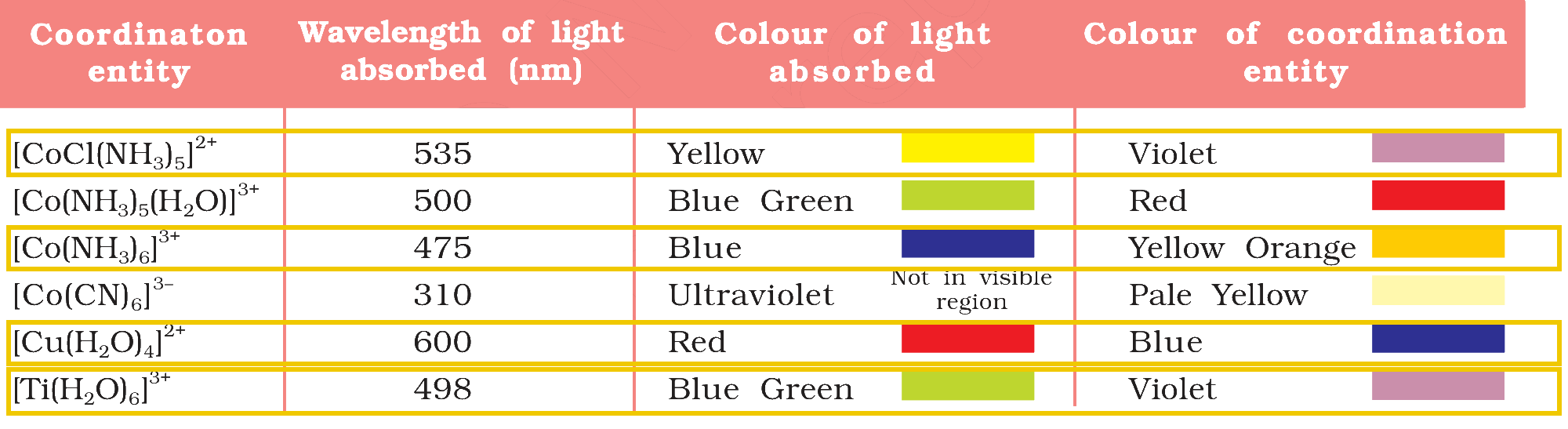
Match the wavelength of light absorbed given in List-I with the color of light absorbed in List-II
|
List-I |
List-II |
|
Wavelength of light absorbed(nm) |
Colour of light absorbed |
|
(A) 535 |
(I) Yellow |
|
(B) 475 |
(II) Red |
|
(C) 600 |
(III) Blue |
|
(D) 498 |
(IV) Blue Green |
Choose the correct answer from the options given below:
Answer & explanation
Correct answer: option 2
The correct answer is Option (2) → (A) - (I), (B) - (III), (C) - (II), (D) - (IV)
A coordination entity absorbs light of one region of the visible spectrum and shows the complementary colour. Going from shorter to longer wavelength, the light absorbed changes from blue through blue-green and yellow to red.
(A) 535 — This matches (I) Yellow. Light of 535 nm absorbed is yellow; a complex that absorbs it looks violet.
(B) 475 — This matches (III) Blue. 475 nm is the shortest wavelength of the four, in the blue region; a complex that absorbs it looks yellow-orange.
(C) 600 — This matches (II) Red. 600 nm is the longest wavelength of the four, at the red end of the spectrum; a complex that absorbs it looks blue.
(D) 498 — This matches (IV) Blue Green. 498 nm lies between the blue and the green regions; a complex that absorbs it looks violet.
Shortcut: The longest wavelength, 600 nm, lies at the red end of the spectrum, so (C)-(II); this leaves Options (2) and (4). The shortest, 475 nm, is blue, so (B)-(III), which leaves Option (2).
NCERT (2026-27 edition):
Colour in Coordination Compounds – …