
Read the following passage and answer the questions.
The figure shows the set-up a student uses to study the photoelectric effect. An evacuated glass tube holds a photosensitive plate C (the emitter) and a metal plate A (the collector). Light from a source S enters through a quartz window and falls on plate C. A battery keeps a potential difference between C and A, and she can change its value. A commutator reverses the polarity, so plate A can be made positive or negative with respect to C. A voltmeter reads this potential difference, and a microammeter reads the photocurrent.
She chooses the frequency of the light by placing coloured filters in its path. She changes the intensity by moving the source nearer to or farther from plate C. For each setting, she records the microammeter reading as the potential of A is changed from a large positive value to negative values.
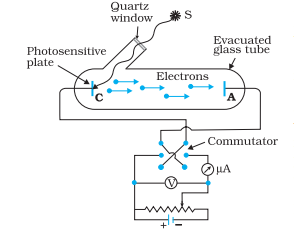
Match List-I with List-II.
| List-I (Change made) | List-II (Effect) |
|---|---|
| (A) A violet filter is used in place of a green filter | (I) The saturation current becomes smaller |
| (B) The source is moved farther from plate C, with the same filter | (II) The threshold frequency becomes higher |
| (C) A red filter is used whose frequency is below the threshold frequency of C | (III) The stopping potential becomes larger in magnitude |
| (D) Plate C is changed to a metal of larger work function that still emits electrons in this light | (IV) No photocurrent flows at any potential of A |
Choose the correct answer from the options given below:
Answer & explanation
Correct answer: option 2
The correct answer is Option (2) → (A)-(III), (B)-(I), (C)-(IV), (D)-(II)
(A) A violet filter is used in place of a green filter — This matches (III) the stopping potential becomes larger in magnitude. Violet light has a higher frequency than green light. The photoelectrons get more kinetic energy, so a larger retarding potential is needed to stop them.
(B) The source is moved farther from plate C, with the same filter — This matches (I) the saturation current becomes smaller. A farther source gives a lower intensity at C. Fewer electrons are emitted each second, so the saturation current falls.
(C) A red filter is used whose frequency is below the threshold frequency of C — This matches (IV) no photocurrent flows at any potential of A. Below the threshold frequency no electrons are emitted, however bright the light is.
(D) Plate C is changed to a metal of larger work function that still emits electrons in this light — This matches (II) the threshold frequency becomes higher. The threshold frequency is \( \nu_0=\phi_0/h \), so a larger work function gives a higher threshold frequency.
NCERT (2026-27):
Effect of frequency of incident radiation on stopping potential – “… The stopping potential is more negative for higher frequencies of incident radiation.”
Effect of frequency of incident radiation on stopping potential – “(ii) For a given photosensitive material and frequency of incident radiation, saturation current is found to be proportional to the intensity of incident radiation …”
Effect of frequency of incident radiation on stopping potential – “(iii) For a given photosensitive material, there exists a certain minimum cut-off frequency of the incident radiation, called the threshold frequency, below which no emission of photoelectrons takes place, no matter how intense the incident light is. …”
Einstein’s Photoelectric Equation: Energy Quantum of Radiation – “… the greater the work function φ0, the higher the minimum or threshold frequency ν0 needed to emit photoelectrons. …”