CUETMOCK
  • Pricing
  • Mentors
Log inStart freeStart free mocks→

First test, then trust

Try a free CUET mock test.

Join 5,00,000+ students who rehearsed exam day on the exact NTA screen before sitting CUET. On the web and on Android.

Start free mocks →Get the Android app
CUETMOCK

India's #1 CUET Mock Test Platform. Original NCERT-based questions on the exact NTA exam screen — trusted by 5,00,000+ students since CUET 2022.

Get it onGoogle PlayScan to download the CUETMOCK app

Mock tests

  • CUET mock test series
  • Browse all papers
  • Commerce mocks
  • Humanities (Arts) mocks
  • Science mocks
  • Languages & GAT mocks
  • Free practice questions
  • Pricing

Resources

  • CUET exam guide
  • CUET syllabus
  • Universities accepting CUET
  • Expert blogs
  • News & notifications
  • Webinars & counselling
  • CUET score calculator
  • How we estimate your rank
  • FAQs

Company

  • About us
  • Our leadership & team
  • Our toppers
  • Mentors
  • For schools
  • Contact us
  • Terms
  • Privacy
  • Refund policy

Talk to us

+91 7696 6630 56info@cuetmock.comWhatsApp us

Our other platforms

  • JEE Mock — For IIT-JEE aspirants
  • NEET Mock — For NEET aspirants

Newsletter

Exam updates, study material and offers — no spam.

© 2026 NYC Ventures Pvt. Ltd.

701-702, Royal Business Park, Zirakpur, Punjab - 140603

  • Terms of use
  • Privacy policy
  • Refund policy
  • Contact us

iCUETMOCK is an independent preparation platform, not affiliated with the National Testing Agency (NTA). Always check exam details on the official NTA website.

  • Home
  • Mock tests
  • CUET guide
  • Pricing
  • Log in
Home/Practice questions/Political Science
Political ScienceContemporary World Politics: Security in the Contemporary World

The Nuclear Non-Proliferation Treaty of 1968 was an arms control Trea…

Read the passage and answer the questions:

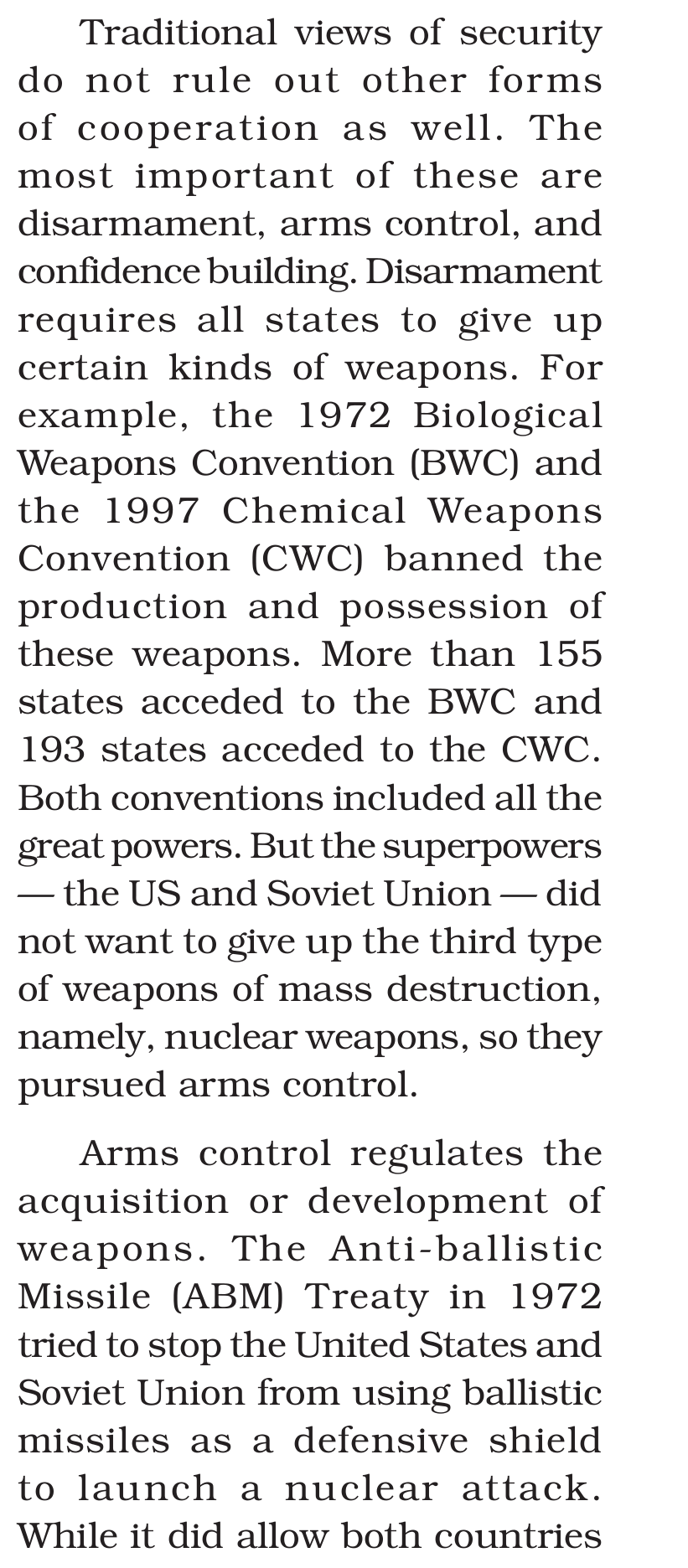
Traditional views of security do not rule out other forms of cooperation as well. The most important of these are disarmament, arms control, and confidence building. The 1972 Biological Weapons Convention (BWC) and the 1997 Chemical Weapons Convention (CWC) banned the production and possession of these weapons. More than 155 states acceded to the BWC and 193 states acceded to the CWC. Both conventions included all the great powers. But the superpowers — the US and Soviet Union — did not want to give up the third type of weapons of mass destruction, namely, nuclear weapons, so they pursued arms control.

Arms control regulates the acquisition or development of weapons. The Anti-ballistic Missile (ABM) Treaty in 1972 tried to stop the United States and Soviet Union from using ballistic missiles as a defensive shield to launch a nuclear attack. While it did allow both countries to deploy a very limited number of defensive systems, it stopped them from large-scale production of those systems.

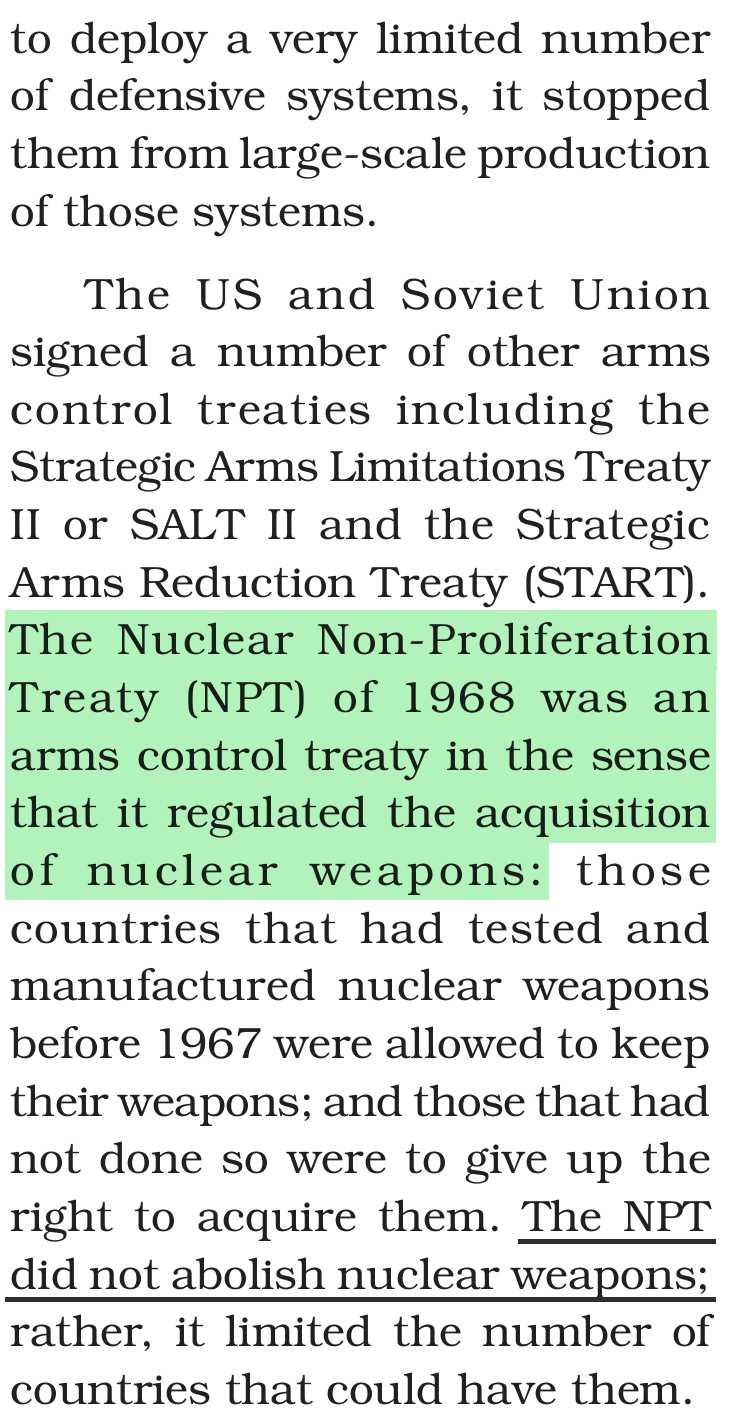
The US and Soviet Union signed a number of other arms control treaties including the Strategic Arms Limitations Treaty II or SALT II and the Strategic Arms Reduction Treaty (START). The Nuclear Non-Proliferation Treaty (NPT) of 1968 was an arms control treaty in the sense that it regulated the acquisition of nuclear weapons: those countries that had tested and manufactured nuclear weapons before 1967 were allowed to keep their weapons; and those that had not done so were to give up the right to acquire them. The NPT did not abolish nuclear weapons; rather, it limited the number of countries that could have them.

The Nuclear Non-Proliferation Treaty of 1968 was an arms control Treaty because:

Answer & explanation+

Correct answer: option 1

The correct answer is Option (1) → It regulated the acquisition of nuclear weapons

Option (1) It regulated the acquisition of nuclear weapons — Correct. The NPT of 1968 was an arms control treaty in the sense that it regulated the acquisition of nuclear weapons, since arms control regulates the acquisition or development of weapons.

Option (2) The US and the Soviet Union signed it — Incorrect. Who signed a treaty does not decide its type; what makes it arms control is that it regulated the acquisition of weapons.

Option (3) It was unfavourable to BWC and CWC — Incorrect. The BWC and CWC are disarmament conventions; the NPT was not set against them.

Option (4) The NPT did not abolish nuclear weapons — Incorrect. This is a true fact about the NPT, but not doing away with nuclear weapons is not what makes a treaty one of arms control; regulating their acquisition is.

Note: One can argue that Option (4) is also a reason, because not abolishing the weapons is what separates arms control from disarmament, which requires states to give up certain kinds of weapons. The passage, however, gives the reason in its own words: the NPT was an arms control treaty in the sense that it regulated the acquisition of nuclear weapons. Option (1) is marked as per the NTA answer key.


NCERT: Contemporary World Politics — Chapter 5: Security in the Contemporary World (2025-26)

NCERT extractNCERT extract

Advertisement

Practise more on Contemporary World Politics: Security in the Contemporary World

Chapter-wise mocks on the real NTA exam screen, with solutions and your rank. Your first mocks are free.

Start free mocks →

Advertisement

Next questions

  1. A business has concentrated on producing goods with fewer resources i.e. cutting down cost. As a result, the target production is not achie…Business Studies · Nature and significance of Management
  2. Select the option that is related to the third number in the same way as the second number is related to the first number. 4 : 41 : : 7 : ?General Aptitude Test · General Ability
  3. What are interhalogen compounds used as?Chemistry · Inorganic: P Block Elements
  4. Which country was the winner of T20 World Cup 2022 for the Blind?General Aptitude Test · Current Affairs
  5. How debt to capital employed ratio calculated?Accountancy Part B · Accounting Ratios
  6. Phytophagous insects feed on :Biology · Organisms and Populations
  7. Who was the First Prime Minister belonging to a non-Congress party?Political Science · Politics in India Since Independence: Crisis of democratic Order
  8. Four letter-clusters have been given, out of which three are alike in some manner and one is different. Select the odd letter-cluster.General Aptitude Test · General Ability
  9. Which of the following terms are include in the preamble of the Constitution of India? A. JusticeB. LibertyC. EqualityD. MonarchyE. Dual ci…Legal Studies · Human Rights in India
  10. Select the most appropriate ANTONYM of the given word. CONSPICUOUSEnglish · Antonyms