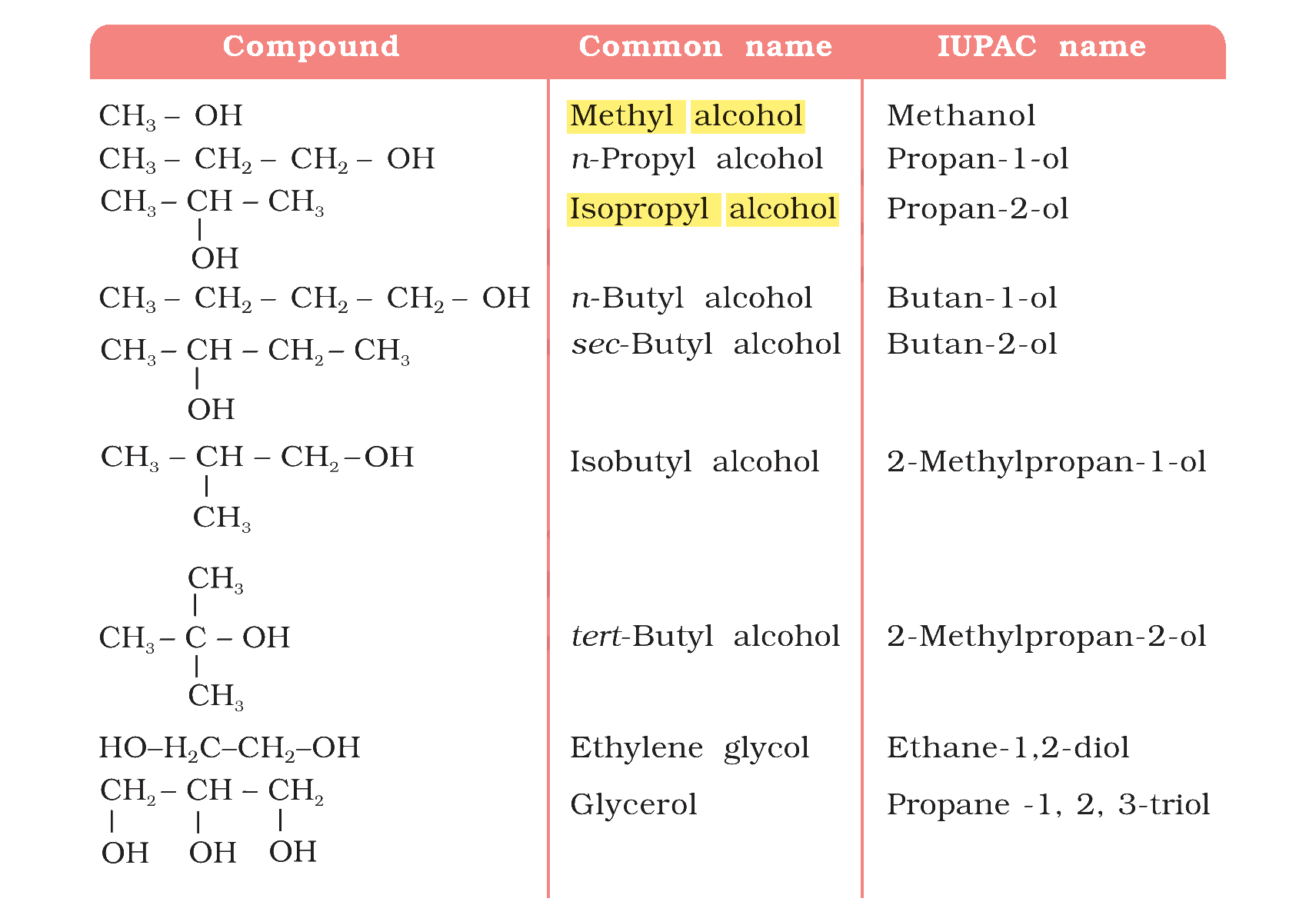
Match List-I with List-II.
| List-I | List-II |
| (A) CH3–OH | (I) Allyl alcohol |
| (B) CH3CH2–OH | (II) Methyl alcohol |
| (C) H2C=CH–CH2–OH | (III) Isopropyl alcohol |
| (D) (CH3)2CH–OH | (IV) Ethyl alcohol |
Choose the correct answer from the options given below:
Answer & explanation
Correct answer: option 1
The correct answer is Option (1) → A-II, B-IV, C-I, D-III
The common name of an alcohol is the common name of its alkyl group followed by the word “alcohol”.
(A) CH3–OH — This matches (II) Methyl alcohol. The group is methyl, \( \ce{CH3-} \).
(B) CH3CH2–OH — This matches (IV) Ethyl alcohol. The group is ethyl, \( \ce{CH3CH2-} \).
(C) H2C=CH–CH2–OH — This matches (I) Allyl alcohol. The group \( \ce{CH2=CH-CH2-} \) is the allyl group; the –OH is on the sp3 carbon next to the double bond.
(D) (CH3)2CH–OH — This matches (III) Isopropyl alcohol. The –OH is on the middle carbon of a three-carbon chain: the isopropyl group, \( \ce{(CH3)2CH-} \).
NCERT (2026-27 edition):
7.1.1 Alcohols— Mono, Di, Tri or Polyhydric alcohols – “Allylic alcohols: In these alcohols, the —OH group is attached to a sp3 hybridised carbon adjacent to the carbon-carbon double bond, that is to an allylic carbon.”
7.2 Nomenclature – “(a) Alcohols: The common name of an alcohol is derived from the common name of the alkyl group and adding the word alcohol to it. For example, CH3OH is methyl alcohol.”
Table 7.1: Common and IUPAC Names of Some Alcohols