
Which of the following group of cells are not diploid?
Answer & explanation
Correct answer: option 3
The correct answer is Option (3)- Secondary spermatocytes.
Spermatogonial cells, germinal epithelial cells, and primary spermatocytes are all diploid (2n).
Secondary spermatocytes are formed after the first meiotic division of primary spermatocytes and are haploid (n).
The primary sex organs – the testis in the males produce gametes, i.e, sperms by the process called gametogenesis.
In testis, the immature male germ cells (spermatogonia) produce sperms by spermatogenesis that begins at puberty.
The spermatogonia (sing. spermatogonium) present on the inside wall of seminiferous tubules multiply by mitotic division and increase in numbers.
Each spermatogonium is diploid and contains 46 chromosomes. Some of the spermatogonia called primary spermatocytes periodically undergo meiosis.
A primary spermatocyte completes the first meiotic division (reduction division) leading to formation of two equal, haploid cells called secondary spermatocytes, which have only 23 chromosomes each.
The secondary spermatocytes undergo the second meiotic division to produce four equal, haploid spermatids. But a single secondary spermatocyte will produce only 2 sperms.The spermatids are transformed into spermatozoa (sperms) by the process called spermiogenesis.
After spermiogenesis, sperm heads become embedded in the Sertoli cells, and are finally released from the seminiferous tubules by the process called spermiation.
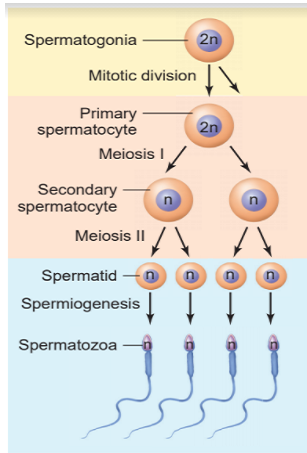
spermatogenesis