
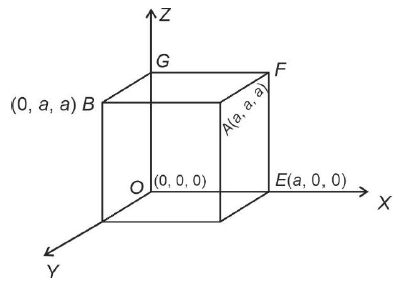
If the given figure is a cuboid, then the acute angle between the diagonals OA and BE is
Answer & explanation
Correct answer: option 4
The correct answer is Option (4) → \(\cos^{-1}\left(\frac{1}{3}\right)\)
From the figure, O = (0, 0, 0), A = (a, a, a), B = (0, a, a) and E = (a, 0, 0). The diagonals as vectors:
\( \overrightarrow{OA} = a\hat{\imath} + a\hat{\jmath} + a\hat{k} \)
\( \overrightarrow{BE} = (a - 0)\hat{\imath} + (0 - a)\hat{\jmath} + (0 - a)\hat{k} = a\hat{\imath} - a\hat{\jmath} - a\hat{k} \)
\( |\overrightarrow{OA}| = |\overrightarrow{BE}| = \sqrt{a^2 + a^2 + a^2} = \sqrt{3}\,a \)
For the acute angle \(\theta\), take the modulus of the dot product:
\( \displaystyle \cos\theta = \frac{|\overrightarrow{OA}\cdot\overrightarrow{BE}|}{|\overrightarrow{OA}|\,|\overrightarrow{BE}|} \)
\( \displaystyle = \frac{|a^2 - a^2 - a^2|}{\sqrt{3}\,a \times \sqrt{3}\,a} \)
\( \displaystyle = \frac{a^2}{3a^2} = \frac{1}{3} \)
\( \displaystyle \theta = \cos^{-1}\left(\frac{1}{3}\right) \)