Match List-I with List-II
| List-I | List-II | ||
| Rural settlement pattern | Location | ||
| (A) | Circular | (I) | Along a Levee |
| (B) | T-Shaped | (II) | Convergence of Several roads |
| (C) | Linear | (III) | Trijunction |
| (D) | Star | (IV) | Around a lake |
Choose the correct answer from the options given below:
Answer & explanation
Correct answer: option 4
The correct answer is Option (4) → (A)-(IV), (B)-(III), (C)-(I), (D)-(II)
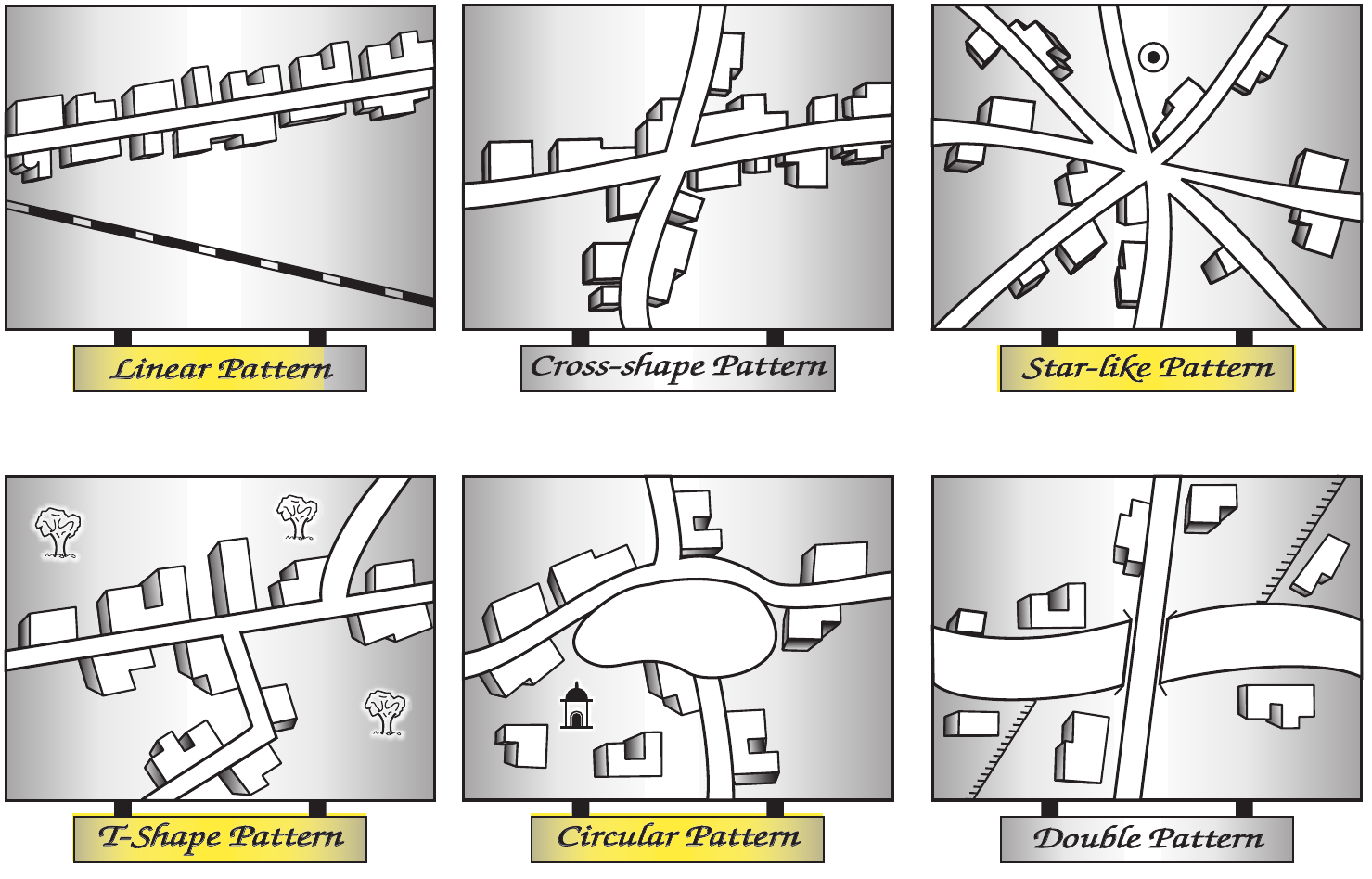
(A) Circular — this matches (IV) Around a lake. Circular villages grow around lakes and tanks.
(B) T-Shaped — this matches (III) Trijunction. T-shaped villages grow where three roads meet.
(C) Linear — this matches (I) Along a Levee. In a linear village the houses stand in a line along a road, railway line, river, canal or levee.
(D) Star — this matches (II) Convergence of Several roads. Where several roads meet, houses are built along each road, and the village takes the shape of a star.
Note: This question is taken from the pre-rationalised NCERT book. The latest edition (2026-27) does not have this part. An extract of the pre-rationalised NCERT book is given below for the benefit of students.
Pre-rationalised NCERT: “Rural Settlement Patterns … (a) Linear pattern: In such settlements houses are located along a road, railway line, river, canal edge of a valley or along a levee.” “(c) Circular pattern: Circular villages develop around lakes, tanks and sometimes the village is planned in such a way that the central part remains open and is used for keeping the animals to protect them from wild animals.” “(d) Star like pattern: Where several roads converge, star shaped settlements develop by the houses built along the roads.” “(e) T-shaped, Y-shaped, Cross-shaped or cruciform settlements: T-shaped settlements develop at tri-junctions of the roads (T) while Y-shaped settlements emerge as the places where two roads converge on the third one and houses are built along these roads.”
Fig. 10.5: Rural Settlement Patterns |