
CUETMOCK
  • Pricing
  • Mentors
Log inStart freeStart free mocks→

First test, then trust

Try a free CUET mock test.

Join 5,00,000+ students who rehearsed exam day on the exact NTA screen before sitting CUET. On the web and on Android.

Start free mocks →Get the Android app
CUETMOCK

India's #1 CUET Mock Test Platform. Original NCERT-based questions on the exact NTA exam screen — trusted by 5,00,000+ students since CUET 2022.

Get it onGoogle PlayScan to download the CUETMOCK app

Mock tests

  • CUET mock test series
  • Commerce mocks
  • Humanities (Arts) mocks
  • Science mocks
  • Languages & GAT mocks
  • Free practice questions
  • Pricing

Resources

  • CUET exam guide
  • CUET syllabus
  • Universities accepting CUET
  • Expert blogs
  • News & notifications
  • Webinars & counselling
  • CUET score calculator
  • How we estimate your rank
  • FAQs

Company

  • About us
  • Our leadership & team
  • Our toppers
  • Mentors
  • For schools
  • Contact us
  • Terms
  • Privacy
  • Refund policy

Talk to us

+91 7696 6630 56info@cuetmock.comWhatsApp us

Our other platforms

  • JEE Mock — For IIT-JEE aspirants
  • NEET Mock — For NEET aspirants

Newsletter

Exam updates, study material and offers — no spam.

© 2026 NYC Ventures Pvt. Ltd.

701-702, Royal Business Park, Zirakpur, Punjab - 140603

  • Terms of use
  • Privacy policy
  • Refund policy
  • Contact us

iCUETMOCK is an independent preparation platform, not affiliated with the National Testing Agency (NTA). Always check exam details on the official NTA website.

  • Home
  • Mock tests
  • CUET guide
  • Pricing
  • Log in
Home/Practice questions/Chemistry
ChemistryPhysical: Chemical Kinetics

Statement I: A catalyst increases the rate of a reaction.Statement II…

Statement I: A catalyst increases the rate of a reaction.

Statement II: A catalyst provides an alternate pathway (reaction mechanism) for the reaction, which has a lower activation energy.

Answer & explanation+

Correct answer: option 1

The correct answer is Option (1) → Both Statement I and Statement II are correct and Statement II is the correct explanation of Statement I.

The activation energy (Ea) is the energy barrier the reactants must cross to form products. The smaller the barrier, the larger the fraction of molecules that can cross it.

Statement I: A catalyst increases the rate of a reaction. — True. A catalyst increases the rate of a reaction without itself undergoing any permanent chemical change.

Statement II: A catalyst provides an alternate pathway (reaction mechanism) for the reaction, which has a lower activation energy. — True. The catalyst opens a new path with a lower potential energy barrier between the same reactants and products.

Why Statement II explains Statement I?

  • In the Arrhenius equation, k = Ae−Ea/RT, the factor e−Ea/RT is the fraction of molecules with energy equal to or greater than Ea.

  • A lower Ea makes this fraction larger, so k rises and the reaction goes faster. The rate increases because the catalyst lowers the activation energy.

NCERT (2026-27 edition):
3.4.1 Effect of Catalyst – “A catalyst is a substance which increases the rate of a reaction without itself undergoing any permanent chemical change. … It is believed that the catalyst provides an alternate pathway or reaction mechanism by reducing the activation energy between reactants and products and hence lowering the potential energy barrier as shown in Fig. 3.11. It is clear from Arrhenius equation (3.18) that lower the value of activation energy faster will be the rate of a reaction.”

    \( \displaystyle k=A\,e^{-E_a/RT} \qquad (3.18) \)
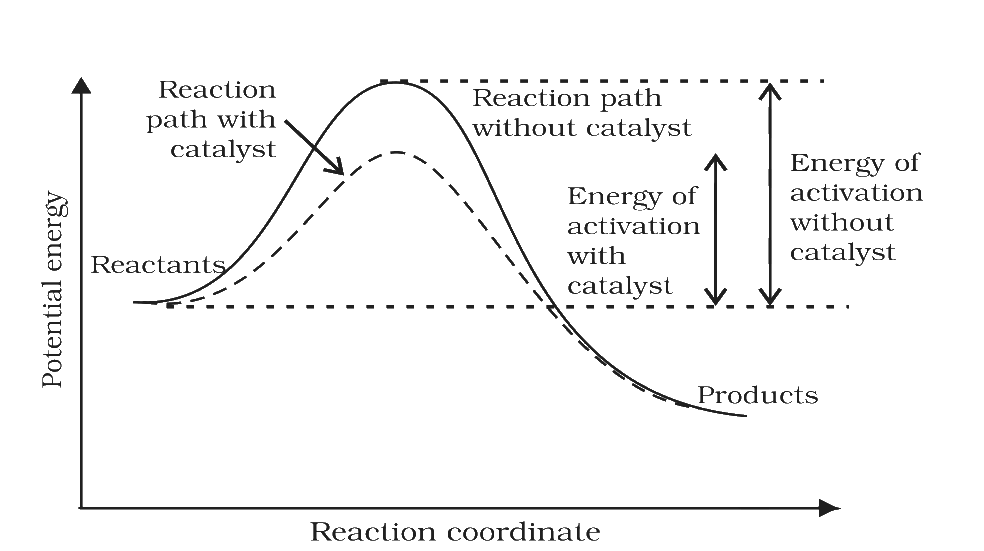
Fig. 3.11

Fig. 3.11: Effect of catalyst on activation energy

Advertisement

Practise more on Physical: Chemical Kinetics

Chapter-wise mocks on the real NTA exam screen, with solutions and your rank. Your first mocks are free.

Start free mocks →

Advertisement

Next questions

  1. If 7A = 4B = 14 C, then what is A : B : C?General Aptitude Test · Numerical Ability
  2. Who are categorized as OBCs in the Indian administrative classification?Political Science · Politics in India Since Independence: Recent Developments in Indian Politics
  3. Which of the following is a combined factor income that cannot be separated into various income components?Economics · Macro Economics: National Income Accounting
  4. Arrange the following sentences in a logical order to form a coherent paragraph:(A) After that, it was chilled, packed in pouches and loade…English · Arrange in Meaningful Sequence
  5. Abanindranath Tagore painted Journey’s End in 1913. Which of the following are other works by him?Fine Arts · The Bengal School and Cultural Nationalism
  6. Pick the value of secθ for an acute angle θ whose sine and cosine obey 7sin^2θ+3cos^2θ=4 .General Aptitude Test · Quantitative Reasoning
  7. Kunal took a loan at 8% per annum simple interest for 3 years and repaid Rs 22940 in all, including interest. What was the amount of the lo…General Aptitude Test · Numerical Ability
  8. In a first-order reaction, half of the reaction is completed in 100 s. The time required for 99% of the reaction to be completed is:Chemistry · Physical: Chemical Kinetics
  9. If the system of equations 2x + 5y + 8z = 0, x + 4y + 7z = 0, 6x + 9y – λz = 0 has a non-trivial solution, then λ is equal toMaths. Section A · Determinants
  10. Select the most appropriate modal to complete the sentence:Sunil’s shift ends at nine, so I am not sure he will come to the Holi party. He…English · Grammar: Modal