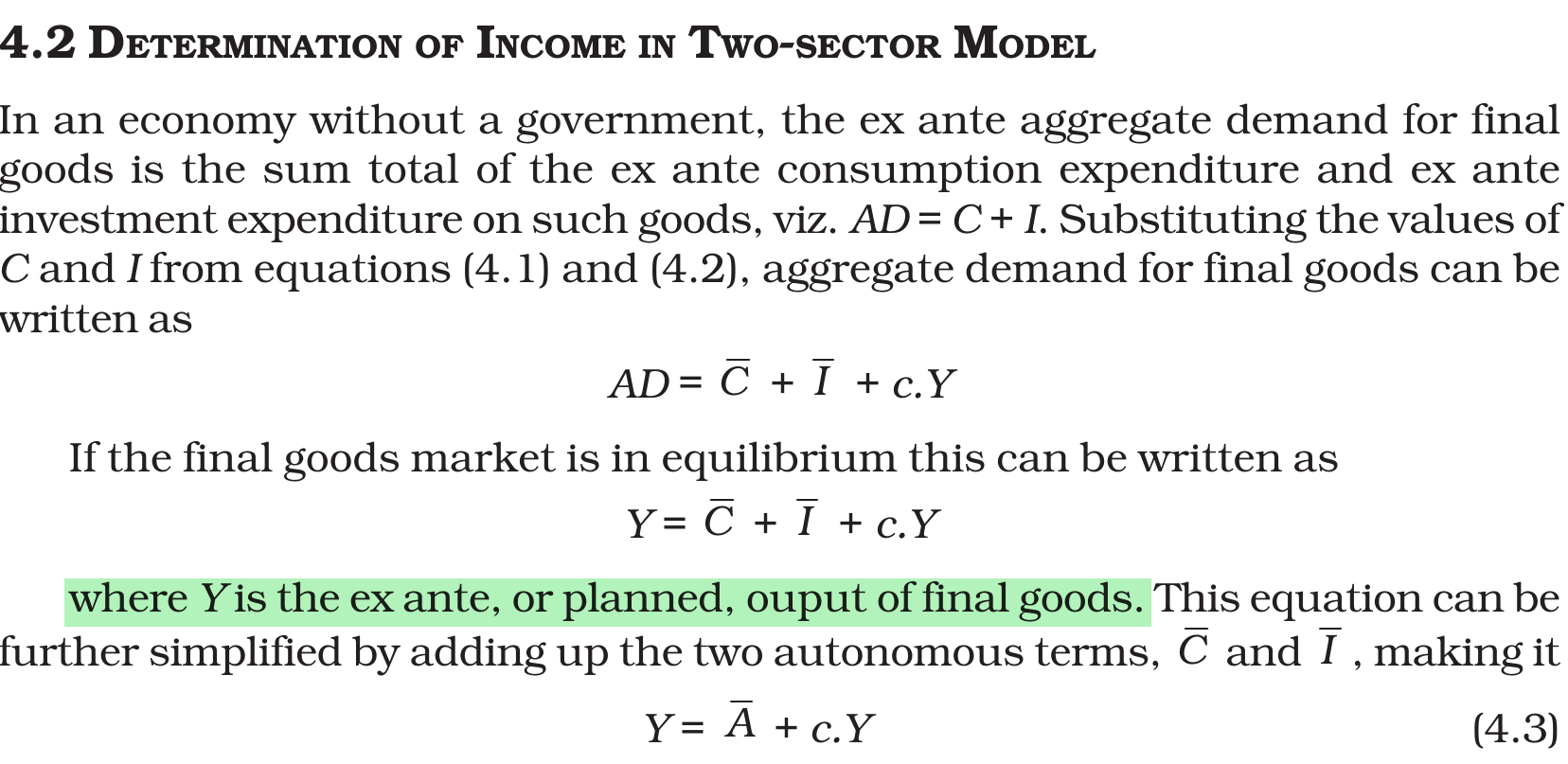
Level of planned output coincides with planned expenditure when:
(AD = Aggregate Demand, AS = Aggregate Supply)
Answer & explanation
Correct answer: option 1
The correct answer is Option (1) → \( AD=AS \)
Planned output equals planned expenditure when aggregate demand equals aggregate supply. Aggregate demand (AD) is what people and firms plan to spend on final goods. Aggregate supply (AS) is what firms plan to produce.
Option (1) \( AD=AS \) — Correct. Firms sell all that they planned to produce, and stocks do not change by accident. So output has no reason to change, and the economy is in equilibrium.
Option (2) \( AD>AS \) — Incorrect. Buyers plan to buy more than firms plan to produce. Stocks run down, and firms raise output.
Option (3) \( AD < AS \) — Incorrect. Firms plan to produce more than buyers plan to buy. Stocks pile up in the warehouses, and firms cut output.
Option (4) Income is Zero — Incorrect. Even at zero income, people have some consumption and firms plan some investment. So AD is above zero while output is zero.
NCERT (2026-27): Introductory Macroeconomics — Chapter 4: Determination of Income and Employment
NCERT (2026-27): “4.2 Determination of Income in Two-Sector Model … A word of caution is in order. The term Y on the left hand side of equation (4.3) represents the ex ante output or the planned supply of final goods. On the other hand, the expression on the right hand side denotes ex ante or planned aggregate demand for final goods in the economy. Ex ante supply is equal to ex ante demand only when the final goods market, and hence the economy, is in equilibrium. Equation (4.3) should not, therefore, be confused with the accounting identity of Chapter 2, which states that the ex post value of total output must always be equal to the sum total of ex post consumption and ex post investment in the economy. If ex ante demand for final goods falls short of the output of final goods that the producers have planned to produce in a given year, equation (4.3) will not hold. Stocks will be piling up in the warehouses which we may consider as unintended accumulation of inventories.…” |