Ethanol cannot be prepared from :
Answer & explanation
Correct answer: option 3
The correct answer is Option (3) → \(C_2H_5COOCH_3\)
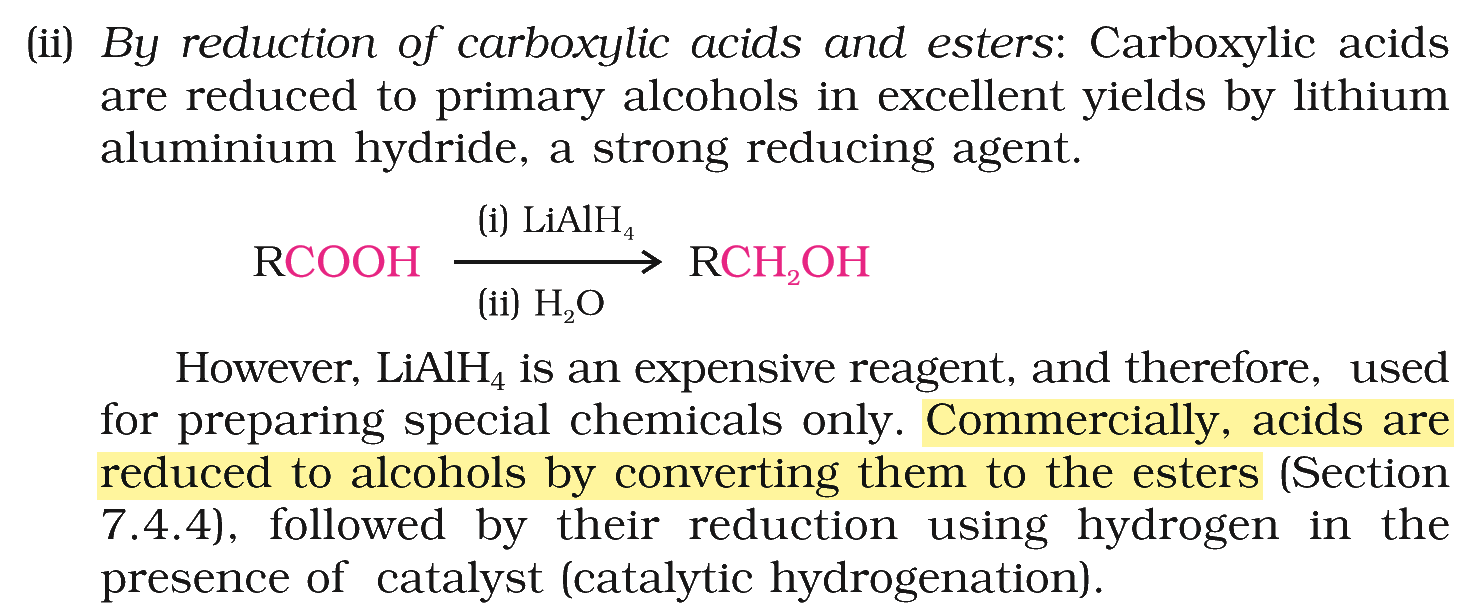
An ester RCOOR′ gives the alcohol R′OH from its alkoxy part on hydrolysis, and on reduction (\( \ce{H2} \) with a catalyst, or \( \ce{LiAlH4} \)) it gives R′OH together with \( \ce{RCH2OH} \) from its acyl part. So ethanol can come from an ester only if the alkoxy group is –OC2H5 or the acyl group is CH3CO–.
Option (1) ethyl benzoate — Gives ethanol. Its alkoxy group is ethyl, so hydrolysis gives ethanol.
\( \ce{C6H5COOC2H5 + H2O} \xrightarrow{\ce{H+}} \ce{C6H5COOH + C2H5OH} \)
Option (2) \(CH_3CH_2CH_2COOC_2H_5\) — Gives ethanol. Ethyl butanoate also has an ethoxy group.
\( \ce{C3H7COOC2H5 + H2O} \xrightarrow{\ce{H+}} \ce{C3H7COOH + C2H5OH} \)
Option (3) \(C_2H_5COOCH_3\) — Does not give ethanol. Methyl propanoate gives methanol and propanoic acid on hydrolysis, and methanol and propan-1-ol on reduction.
\( \ce{C2H5COOCH3 + H2O} \xrightarrow{\ce{H+}} \ce{C2H5COOH + CH3OH} \)
\( \ce{C2H5COOCH3} \xrightarrow[\text{catalyst}]{\ce{H2}} \ce{CH3CH2CH2OH + CH3OH} \)
Option (4) \(CH_3COOC_2H_5\) — Gives ethanol. Ethyl ethanoate gives ethanol from both parts on reduction.
\( \ce{CH3COOC2H5} \xrightarrow[\text{catalyst}]{\ce{H2}} \ce{2C2H5OH} \)
NCERT (2026-27 edition):
By Reduction of Carboxylic Acids and Esters