
Meera, a history student, is studying how families and rulers in early India worked. In a museum she sees a terracotta panel from West Bengal, made around the seventeenth century, that shows a scene from a long epic. Her teacher tells her that Brahmanas compiled normative texts laying down rules of ideal social behaviour for different social groups. The teacher adds that many ruling families claimed that the throne passed from father to son, and that historians test such claims against ritual texts, inscriptions and accounts of royal women.
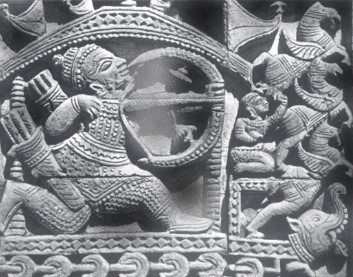
The terracotta panel Meera sees, shown in the picture above, depicts a scene from which epic?
Answer & explanation
Correct answer: option 1
The correct answer is Option (1) → Mahabharata
The terracotta sculpture from West Bengal, made around the seventeenth century, shows a scene from the Mahabharata.
NCERT (2026-27): “Early Societies THREE (C. 600 BCE- … “In focusing on the Mahabharata, a colossal epic running in its present form into over 100,000 verses with depictions of a wide range of social categories and situations, we draw on one of the richest texts of the subcontinent. It was composed over a period of about 1,000 years (c. 500 BCE onwards), and some of the stories it contains may have been in circulation even earlier. The central story is about two sets of warring cousins. …” |