
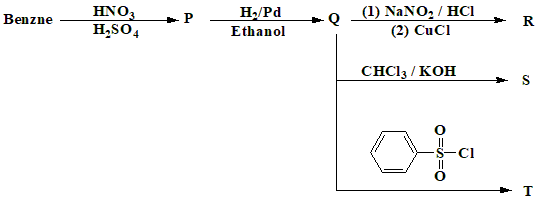
Predict the correct sequence of P, Q, R, S and T
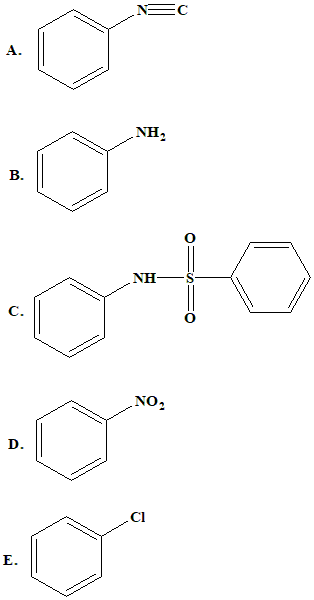
Choose the correct answers from the options given below:
Answer & explanation
Correct answer: option 4
The correct answer is Option (4) → D, B, E, A, C
P — nitration of benzene gives nitrobenzene (D):
\( \ce{C6H6} \) + \( \ce{HNO3} \) (conc. \( \ce{H2SO4} \)) → \( \ce{C6H5NO2} \) + \( \ce{H2O} \)
Q — \( \ce{H2} \)/Pd reduces the nitro group to an amino group: aniline (B):
\( \ce{C6H5NO2} \) + \( \ce{3H2} \) (Pd) → \( \ce{C6H5NH2} \) + \( \ce{2H2O} \)
R — diazotisation at 273–278 K, then CuCl replaces the diazo group by Cl (Sandmeyer reaction): chlorobenzene (E):
\( \ce{C6H5NH2} \) + \( \ce{NaNO2} \) + 2HCl → \( \ce{C6H5N2^{+}Cl^{-}} \) + NaCl + \( \ce{2H2O} \)
\( \ce{C6H5N2^{+}Cl^{-}} \) (CuCl/HCl) → \( \ce{C6H5Cl} \) + \( \ce{N2} \)S — aniline heated with \( \ce{CHCl3} \) and ethanolic KOH gives the foul-smelling isocyanide (carbylamine reaction): phenyl isocyanide (A):
\( \ce{C6H5NH2} \) + \( \ce{CHCl3} \) + 3KOH → \( \ce{C6H5NC} \) + 3KCl + \( \ce{3H2O} \)
T — aniline reacts with benzenesulphonyl chloride (Hinsberg’s reagent) to give the sulphonamide: N-phenylbenzenesulphonamide (C):
\( \ce{C6H5NH2} \) + \( \ce{C6H5SO2Cl} \) → \( \ce{C6H5SO2NHC6H5} \) + HCl