Which one of the following reacts with 50% sodium hydroxide solution to give the corresponding alcohol and acid?
Answer & explanation
Correct answer: option 2
The correct answer is Option (2) → Benzaldehyde
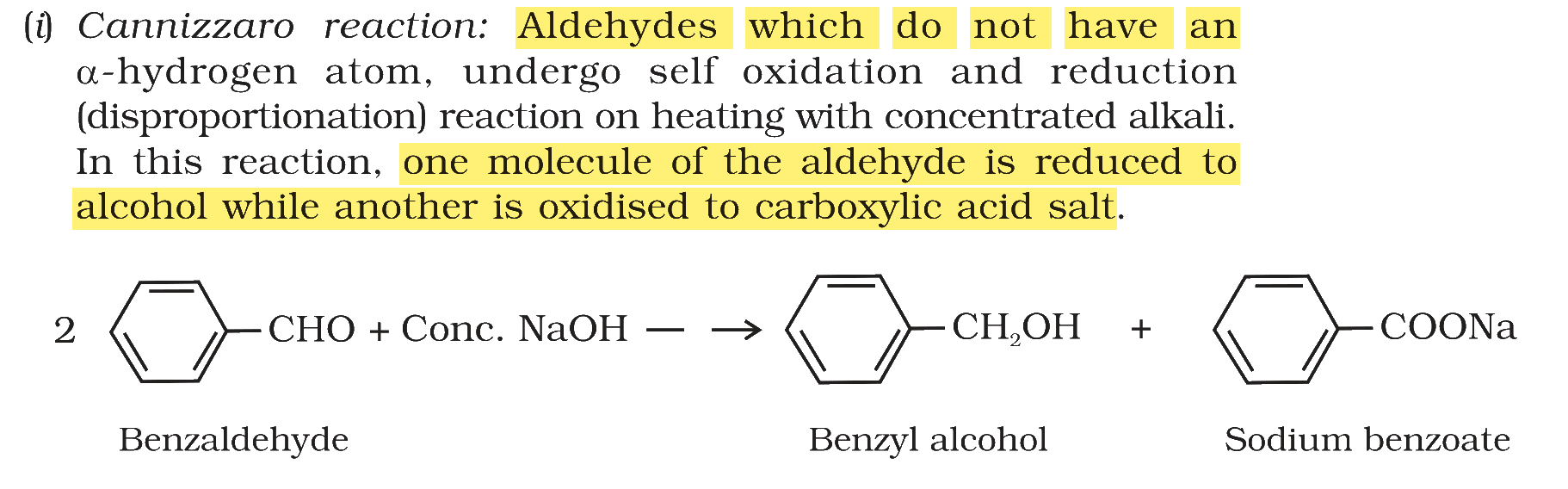
In the Cannizzaro reaction, an aldehyde with no α-hydrogen, heated with concentrated alkali such as 50% NaOH, undergoes self oxidation and reduction: one molecule is reduced to the alcohol and another is oxidised to the carboxylic acid (as its salt).
In benzaldehyde, \( \ce{C6H5CHO} \), the carbonyl carbon is joined directly to the ring, so there is no α-hydrogen. It gives benzyl alcohol and sodium benzoate; acidifying the sodium benzoate gives benzoic acid, the corresponding acid.
Why the other options are incorrect
Option (1) Phenol — Incorrect. Phenol is not an aldehyde; being acidic, it only forms sodium phenoxide and water with NaOH.
Option (3) Butanal — Incorrect. \( \ce{CH3CH2CH2CHO} \) has α-hydrogens (on C-2), so with a base it undergoes aldol condensation instead.
Option (4) Benzoic acid — Incorrect. It is already a carboxylic acid; NaOH only neutralises it to sodium benzoate and water.
NCERT (2026-27 edition):
8.4 Chemical Reactions